
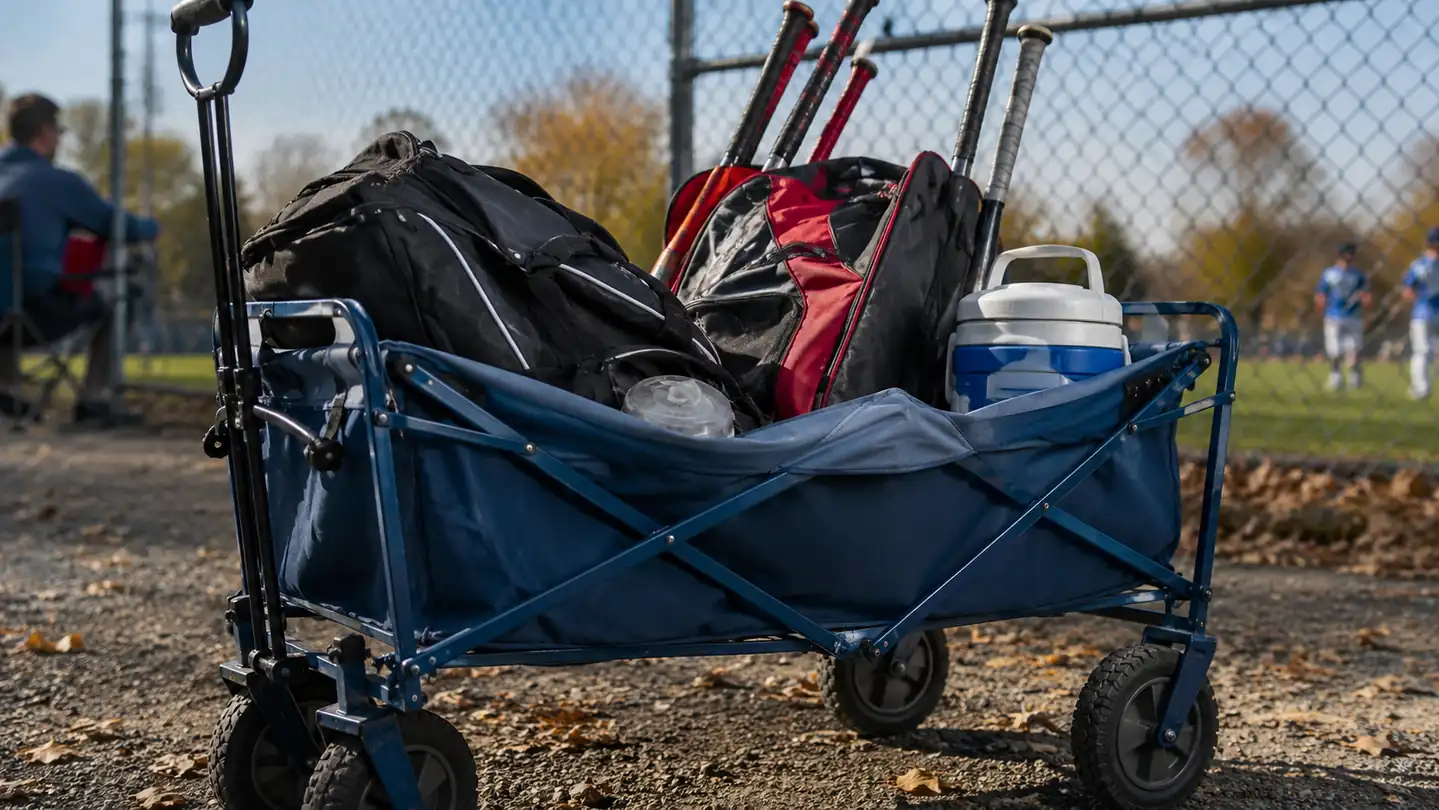
I coach my son Cole's fall ball team, which means every practice and every game I'm the one hauling the team gear from the car to the field: the ball bucket, a couple of bat bags that don't belong to any one kid, a five-gallon water jug, and whatever extra bases or a portable pitching net I decided we needed that day. I bought the Mac Sports folding wagon in early September specifically to stop making three trips across the parking lot before first pitch, and for the most part it has done exactly that job. But six weeks into a fall season that's put this wagon on gravel lots, dirt infields, and a couple of genuinely rutted overflow parking areas, I've also run into the real ceiling of what a soft-sided, fabric-bed wagon can carry and roll over. This is the honest version of that, not the version where everything is five stars because the frame is steel and the price is reasonable.
None of what follows means I regret buying it. It means a folding wagon like this one has a specific job it's built for, and there's a different job that needs a different, heavier piece of equipment, and I'd rather tell you where that line sits than let you find out the way I did.
The Quick Verdict
A genuinely useful folding wagon for grass, pavement, and light gravel duty, but the fabric bed sags under a real coach's load and the small wheels aren't built for rutted dirt or loose stone the way a heavier-duty wagon is.
Amazon Check Today's Price →Before you decide, know exactly what this wagon can and can't carry.
We're covering the sag point, the wheel limits, and when you actually need something heavier below. The short version is it still earns its spot in my trunk every practice day. Check today's price and current stock on Amazon.
Amazon Check Today's Price on Amazon →How I've Used It
Our fall ball fields sit at a rec complex with a gravel overflow lot about seventy yards from the closest dugout, and most weeks I'm parking in that overflow lot because the closer spaces fill up fast with parents dropping off. That means every load I pull with this wagon crosses gravel first, then a strip of mowed grass, then a short run of packed dirt right at the infield edge before it gets to the dugout. It's a more varied surface test than a single backyard or a single ballfield, and it's why I noticed things the marketing copy and the five-star reviews online didn't really prepare me for.
A typical load for me is two bat bags, the team ball bucket, a five-gallon water jug that's genuinely heavy once it's full, and sometimes a folded pitching net if we're working on a drill that day. That combination puts real, uneven weight in the Mac Sports wagon bed most practices, not a single light item riding in an otherwise empty wagon. I've been doing this twice a week for practices plus one game day most weekends since early September, which puts total pulls somewhere north of twenty at this point in the season. Cole is 12 and plays shortstop, and he's usually the one walking alongside me pulling his own bat bag while I handle the team wagon, so I've had a second set of eyes on how the thing behaves under load most days rather than just my own impression from behind the handle.
For a lot of that use, the Mac Sports wagon has been fine. Grass and packed dirt are where it does its best work, and the steel frame underneath the fabric never felt like it was going to fold up or buckle sideways on me even with an uneven load like a heavy water jug on one side and lighter bat bags on the other. The problems showed up specifically at the two ends of that seventy-yard walk: the gravel lot at the start, and the bed sag once everything heavy was actually loaded in.
The Fabric Bed Has a Sag Point, and I Found It Fast
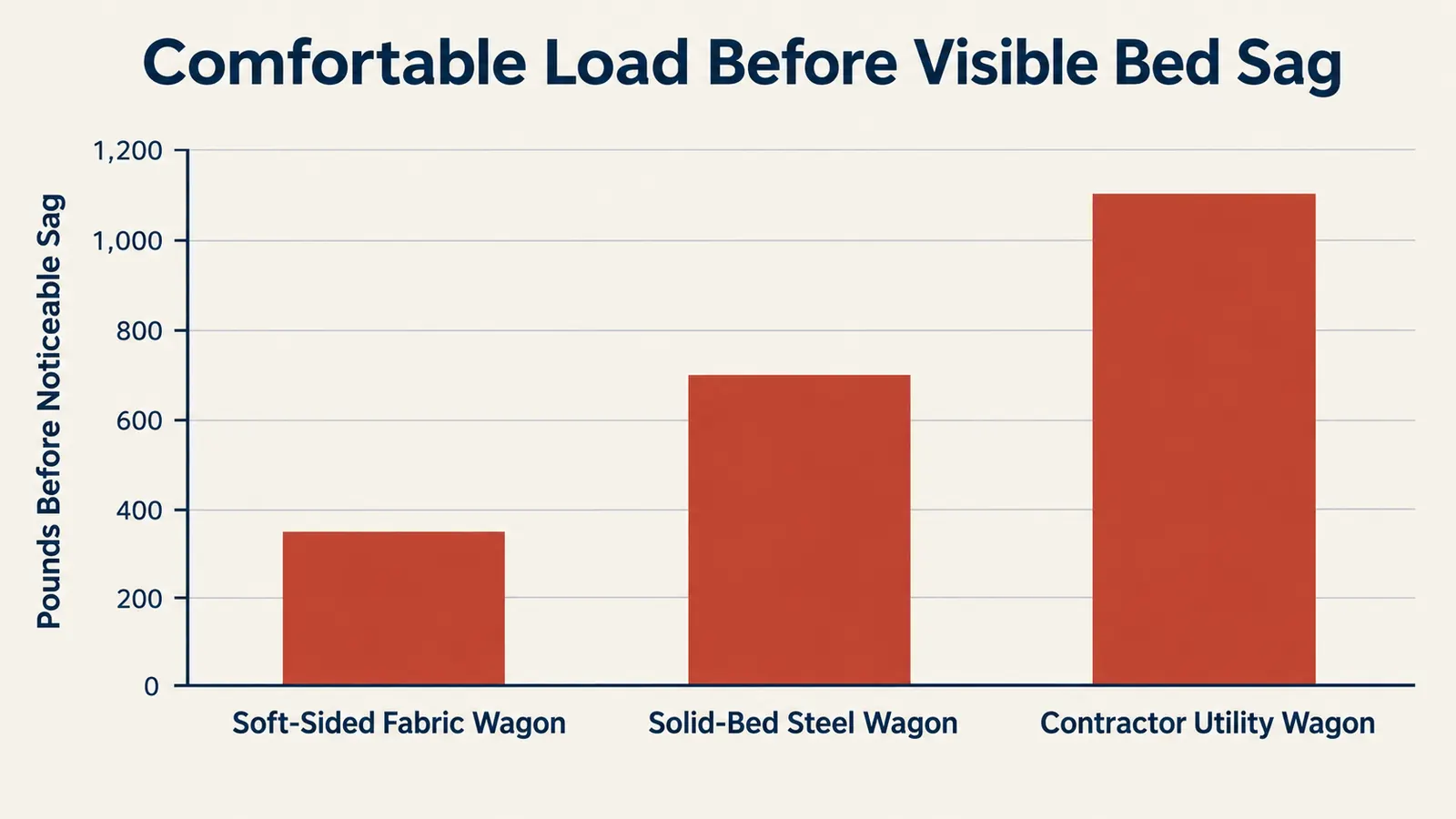
This is the part I want to be direct about, because I don't think most reviews get specific enough on it. The wagon bed is fabric stretched across the steel frame, not a solid floor, and fabric behaves differently under weight than a rigid bed does. With a light or evenly distributed load, you don't notice it. Add a full five-gallon water jug, which by itself is around 40 pounds, next to a couple of bat bags, and the middle of the bed sags down into a visible bowl shape between the frame rails almost immediately.
That sag isn't just cosmetic. Once the bed dips low enough, the bottom of that dip gets closer to the wheels and the ground than the frame rails suggest it should, and on a couple of practices where I hit a rougher patch of dirt, I heard the underside of the loaded bed brush against a raised rut before I adjusted how I'd packed the load. It never tore the fabric and it never damaged anything, but it told me plainly that this bed has a real capacity where it stops behaving like a rigid cart and starts behaving like a hammock, and that point comes sooner than the 150-pound frame rating would lead you to expect. The frame can handle more weight than the fabric bed comfortably carries without sagging into trouble.
My fix has been boring but effective: I load the water jug dead center now instead of to one side, and I try to keep the heaviest single item as close to the axle line as I can rather than toward either end. That spreads the sag evenly instead of tilting the whole load, and it's mostly solved the ground-clearance issue. But it's a workaround I had to figure out myself, not something the wagon or its instructions warned me about. I mentioned the sag to another coach on our team, who owns a similar folding wagon from a different brand, and he said his does the same thing under a full jug and a couple of bags, which tells me this isn't a defect specific to my unit. It's a characteristic of soft-sided wagons generally, not a flaw in this particular one, and that distinction matters if you're trying to decide whether to return a unit that sags or just adjust how you pack it.
The Wheels Are Fine on Grass and Struggle on Loose Gravel
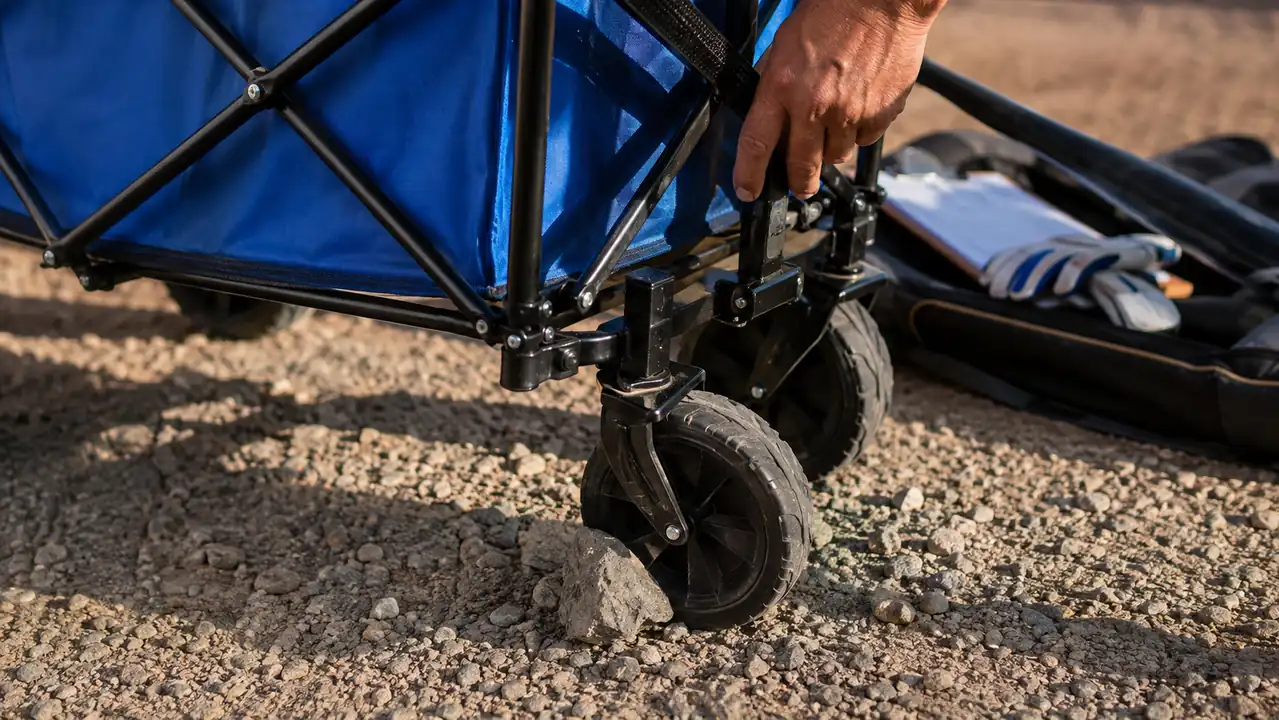
The wheels on this wagon are small and hard, built more for rolling smoothly on a flat, relatively firm surface than for absorbing anything uneven underneath them. On mowed grass and on the packed dirt near our infield, that's not a problem, they roll cleanly and don't sink or catch. The gravel overflow lot is a different story. It's coarse gravel, closer to golf-ball-sized stone in a lot of spots than fine crushed rock, and a small hard wheel wants to catch on individual stones instead of rolling over them.
Pulling a loaded wagon across that lot means feeling the front wheels stutter and occasionally stop dead against a stone I have to muscle the wagon over, rather than a smooth, continuous roll. It's not dangerous and it's never dumped a load, but it turns a seventy-yard walk into something closer to a seventy-yard workout on the days the gravel is freshly graded and loose rather than packed down from other cars driving over it. On days after rain, when the gravel settles and compacts a bit, it's noticeably easier, which tells me the wheel size, not the frame or the fabric, is the actual limiting factor here. I've started timing myself without really meaning to, just out of curiosity, and the same walk that takes maybe forty-five seconds on packed dirt can stretch past a minute and a half on the loosest gravel days, mostly because I'm stopping every ten feet or so to give the front wheels a shove over whatever they've caught on.
When I Actually Needed the Heavier-Duty Wagon Instead
There was one specific practice in early October where our field maintenance crew had left a pile of bagged infield mix near the dugout for us to spread ourselves, and I tried using my folding wagon to move four of those bags across the gravel lot in one trip because it seemed faster than four separate carries. That was the moment I found the real edge of this wagon's usefulness. Bagged infield conditioner is dense and awkward, and stacking that much weight low in a fabric bed on gravel is a genuinely different job than hauling bat bags and a water jug on grass. The bed sagged hard, the wheels fought the gravel the whole way, and I ended up unloading two bags halfway across and carrying them the rest of the way by hand anyway.
That's the use case where a heavier-duty wagon earns its higher price. A solid-bed steel utility wagon, the kind built more for a contractor or landscaper hauling mulch, pavers, or bagged material, uses a rigid floor instead of fabric and pairs it with larger pneumatic or semi-pneumatic tires that roll over loose gravel and ruts instead of catching on them. Those wagons cost meaningfully more, often close to double what this one runs, and they're heavier and bulkier to store and fold, which matters if trunk space or garage space is tight. But if your regular hauling involves dense, heavy material on genuinely rough, unmaintained ground, rather than gear bags and coolers on grass and light gravel, that upgrade is worth the extra cost and bulk. I'm not buying one for a fall ball season that mostly needs bat bags moved across a parking lot, but I understand now exactly why those heavier wagons exist and who they're actually for.
Small Things That Add Up Over a Season
Beyond the sag and the gravel wheels, a few smaller details have shown up over six weeks of regular use. The fabric bed picked up a light coating of dust and dirt from the gravel lot almost immediately, and it doesn't wipe clean easily, a quick rinse with a hose handles it but it takes real effort to get the fabric looking fresh again. I also noticed the folding latches get slightly stiffer to release when they're gritty from gravel dust, which means I've started giving the mechanism a quick wipe before folding it rather than fighting it mid-latch.
None of that is a defect. It's what happens to a fabric-and-steel wagon that spends its life on a mix of grass and gravel rather than a clean garage floor between uses. I'd rather you know that going in than discover it yourself and wonder if something's wrong with your particular unit.
What I Liked
- Steel frame stays rigid and square even with uneven, heavy loads
- Handles grass and packed dirt smoothly with no sinking or catching
- Folds flat enough to keep trunk space usable between practices
- Priced well below dedicated heavy-duty utility wagons for the jobs it's actually built for
- Held up structurally through more than twenty pulls in six weeks with no real damage
Where It Falls Short
- Fabric bed sags visibly under a real coach's load, closer to the ground than the frame rating suggests
- Small hard wheels catch and stutter on loose, coarse gravel
- Not built for dense, heavy material like bagged infield mix or mulch on rough ground
- Fabric bed picks up dust and dirt fast and takes real effort to clean
- Folding latches get gritty and stiffer with regular gravel-lot use
The frame never let me down. The fabric bed and the small wheels told me plainly, more than once, exactly where this wagon's job ends and a heavier one's job begins.
Who This Is For
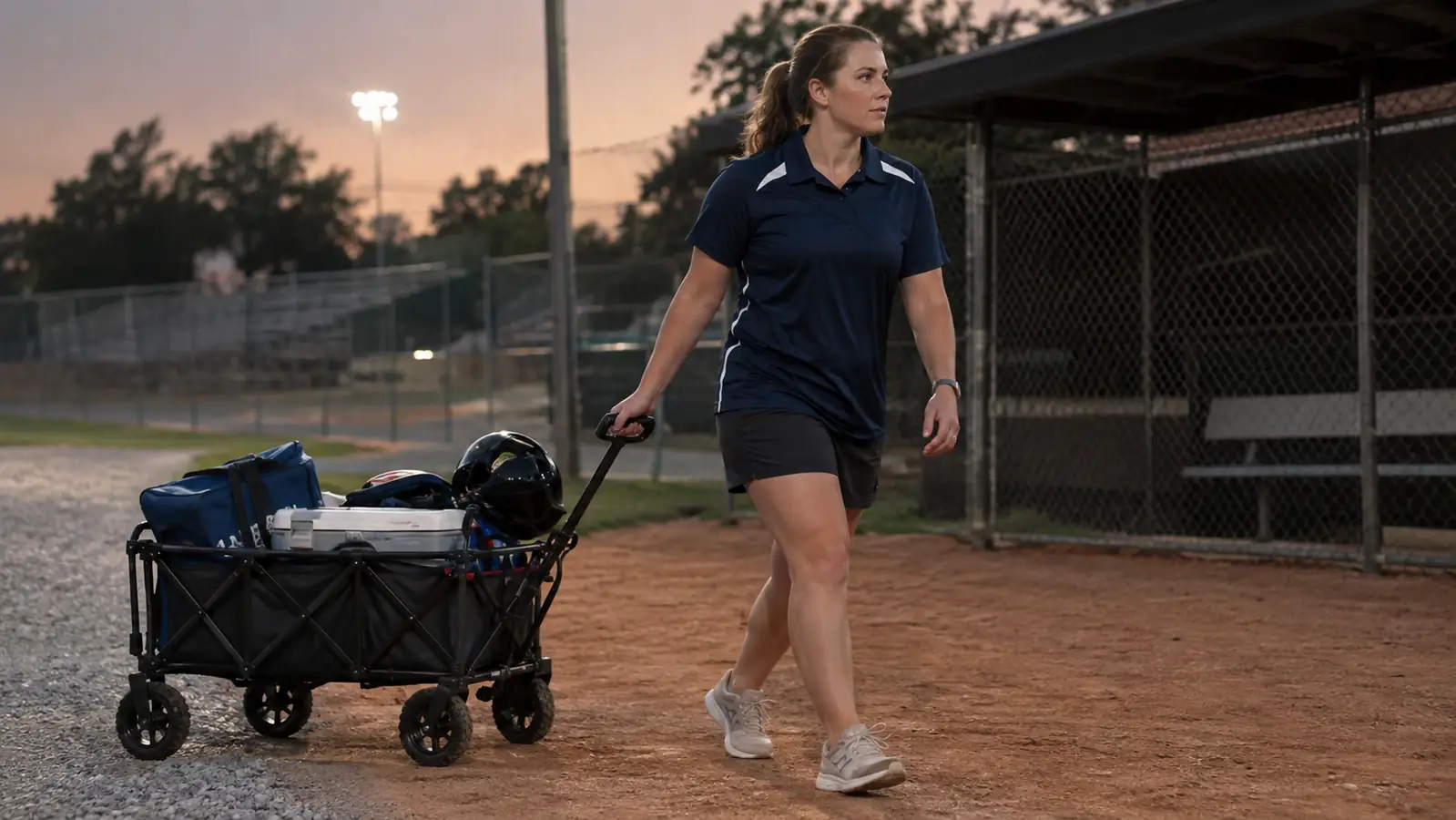
This wagon makes sense for a coach or parent hauling team gear, bat bags, a water jug, a ball bucket, across grass, pavement, and moderate gravel, which covers most rec-league and travel-ball setups I've seen. It's a good fit if your loads are bulky but not dense, gear bags and coolers rather than building material, and if you want something that folds flat enough to live in a trunk between practices without eating all your cargo space. If your season looks anything like mine, mostly grass and dirt with an occasional gravel stretch, this wagon will do the job well. If you want a more personal look at why a family decides to buy one in the first place, one family's story of buying it walks through that decision from the other side.
Who Should Skip It
If your regular hauling means dense, heavy material like bagged infield mix, mulch, or firewood, or if your parking situation is consistently loose, unmaintained gravel or rutted dirt rather than an occasional stretch of it, spend the extra money on a solid-bed utility wagon with bigger tires instead. You'll pay more and store something bulkier, but you won't spend a practice unloading bags halfway across a lot the way I did. I'd also skip this one if you're regularly loading close to that 150-pound frame rating, since the fabric bed will sag into trouble well before the steel frame actually complains. One more genuine advantage: for anyone bouncing between a ball field, a race day, or a tailgate the way a lot of this site's readers do, our long-term review shows how the same wagon holds up loaded with a cooler and camp chairs on gravel across a full summer, worth reading if hauling gear is only one of the jobs you need this wagon to do.
Now that you know exactly where the fabric bed and the wheels meet their limit, decide if it still fits your fields.
For grass, pavement, and moderate gravel, this wagon has earned its spot in my trunk every practice day this fall. Check today's price and current availability on Amazon.
Amazon Check Today's Price on Amazon →