

For most of the last ten years I played golf the way a lot of weekend guys do: I guessed. I'd eyeball a shot, remember that the 150 marker was somewhere back there, add or subtract a club based on a feeling, and swing. Some Saturdays that worked out fine. Most Saturdays I found out on the green that I'd left it thirty feet short or spun one over the back, and I'd tell myself the same thing every time, that I just misjudged it. I hadn't misjudged anything. I never actually had a number.
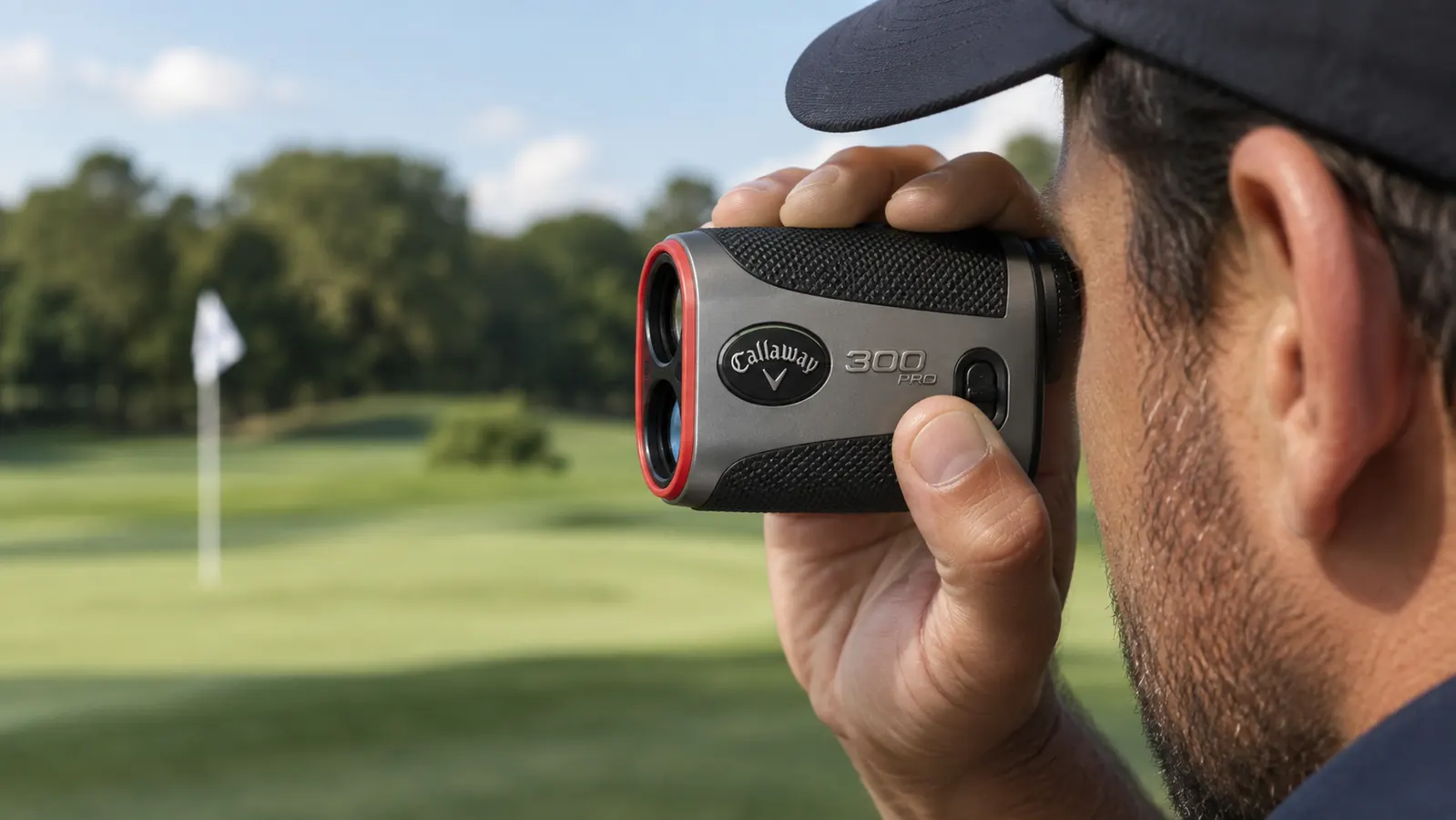
What changed it was picking up a Callaway 300 Pro laser rangefinder two seasons ago, and more specifically, learning to actually use the thing instead of just pointing it at the green and reading whatever number popped up first. A rangefinder in your bag doesn't lower your score by itself. It lowers your score when you use it the same way, every hole, until getting a real yardage before you pick a club is just as automatic as taking your grip. I was carrying roughly a 14 handicap the season I bought it and shooting in the high 80s more often than not. Two full seasons of the routine below and I'm sitting closer to an 11, and the rounds where I break 82 aren't rare anymore. Here's the routine that got me there, along with the parts of it that took longer to get right than I expected.
Stop Guessing Between Two Clubs Every Time You're Not Sure
A gut feeling isn't a yardage. The Callaway 300 Pro gives you a locked, accurate number to the flag in under a second, plus slope-adjusted distance for practice rounds, so club selection stops being a coin flip.
Amazon Check Today's Price on Amazon →Step 1: Get a real number before you touch a club, not after you've already guessed
The habit that made the biggest difference wasn't buying the rangefinder, it was changing the order I do things in. For years I'd walk up to my ball, pick a club based on how the hole looked, then maybe check the yardage if I had time. That's backwards. Now the rangefinder comes out first, before I've formed any opinion about which club feels right, because the second I've already decided on a seven iron, I start unconsciously bending the yardage to match the club instead of the other way around.
It sounds like a small sequencing thing, but it isn't. Golfers talk themselves into a number that supports the swing they already want to make. Getting the laser reading first, before any club is in your hand, takes that bias out of the decision. I range as soon as I get within roughly 200 yards of the green, well before it's my turn to hit, so the number is sitting there waiting instead of being a rushed afterthought while everyone's watching me stand over the ball.
The actual sequence looks like this now: range the flag, check the wind, check the number against my own carry distances for each club, then pick. Four small steps, maybe fifteen seconds total once it's automatic. When I skip straight to the club and check the number after, I'm not really checking anything, I'm just looking for confirmation of a decision I already made, and that's the exact habit that used to leave me short-siding myself two or three times a round.
Step 2: Trust the pin lock, but confirm it before you commit to the number
This is the part that took me the longest to get comfortable with. A laser rangefinder doesn't know you're aiming at the flag, it knows you're aiming at whatever's under the crosshair, and on a lot of holes that includes a tree line, a bunker rim, or a hill behind the green that sits closer than the pin itself. Early on I'd get a reading, assume it was the flag, and hit a club short because I'd actually ranged the fringe grass in front of the pin instead.
The Callaway 300 Pro's PinSeeker mode with the pulse vibration solved that for me once I understood what to look for. When it actually locks onto the flag, the unit gives a small vibration confirmation, a physical signal, not just a number on the screen, that tells you it found the pin and not the background behind it. I don't trust a reading anymore unless I felt that pulse. If I didn't get it, I re-range, sometimes shifting my angle slightly so the flag is cleanly separated from whatever's behind it. That one habit alone probably saved me more strokes than any swing change I made that same year.
On crowded par 3s with bunkers or mounding tight behind the green, I'll take an extra half second and range twice from slightly different spots to make sure both readings agree. Two matching numbers is a real yardage. One number you're not sure about is still a guess, it just looks more official because it came from a laser.
Step 3: Know when slope mode helps you and when it can get you disqualified
Slope mode adjusts your yardage for elevation change, so a shot playing steeply uphill or downhill gets a corrected number that accounts for the extra club it actually takes. I use it constantly in practice rounds and casual Saturday games with my buddies, because it takes the guesswork out of elevation, which is one of the hardest things to judge by eye on an unfamiliar course. Our home course has three holes with real elevation change, and before I had slope data I was routinely a club short on the uphill par 3 and a club long on the downhill one.
But slope-adjusted distance is not legal in USGA rules-of-golf events, and that includes most club championships and any tournament that states it's played under the standard rules. This is exactly why the Callaway 300 Pro has an external slope switch built into the housing instead of burying the setting in a menu. You flip the physical switch to the off position and the slope function is mechanically disabled, which means a tournament official can glance at the unit and visually confirm it's off without you having to prove anything on a screen. I keep mine switched off by default now and only flip it on the morning of a round I know is purely for fun, because forgetting to switch it back is exactly the kind of mistake that gets a card thrown out.
I've also started checking the switch position out loud with whoever I'm playing tournament rounds with, the same way you'd double check you're not carrying an extra club. It takes two seconds and it means nobody's relying on memory alone. A disqualification over a switch position is an embarrassing way to end a round you actually played well.

Step 4: Read the whole green, not just the number to the pin
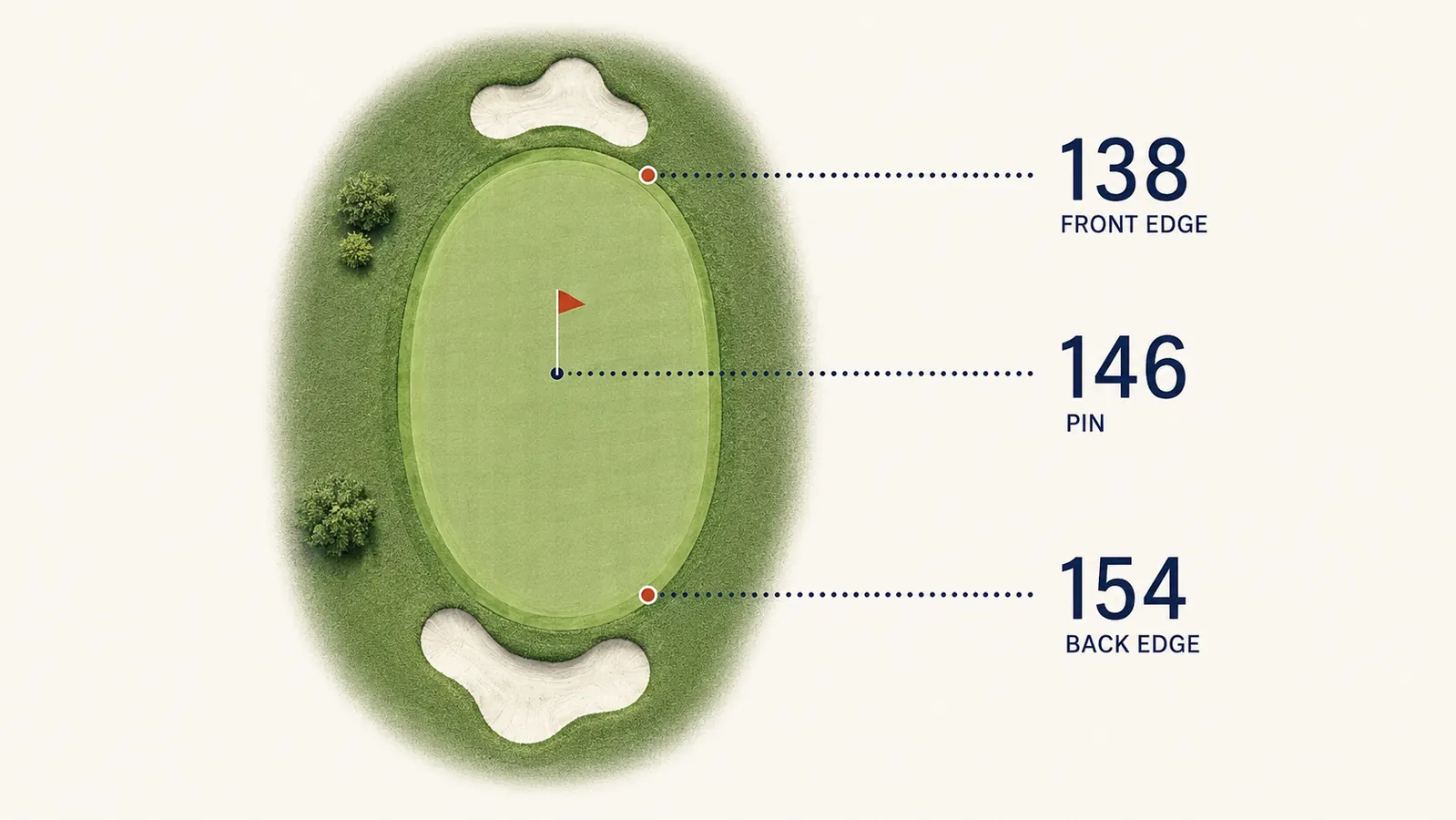
For a long time I only ever ranged the flag. That gives you one number, and one number tells you almost nothing about how much green you actually have to work with. A pin at 146 yards means something completely different if the green is 30 yards deep than if it's 12 yards deep, and hitting it dead-on-number can still leave you short-sided in a bunker if you don't know where the edges are.
Now I range the front edge of the green and the back edge in addition to the flag, especially on greens I haven't played before. If the front edge is 138 and the pin is 146, I know there's real room to land a shot slightly long and still have it release toward the hole. If the front edge is 143 and the pin is 146, that green is basically all carry and I need to commit fully to the number instead of playing a bump-and-run into the front third. That front-to-back read takes maybe ten extra seconds and it's changed how I actually pick targets, not just clubs.
It matters even more when the pin is tucked. On a green with a bunker guarding the front right and the flag sitting eight yards behind it, ranging only the pin will get you a number that flies straight into the sand if you come up even a yard short. Ranging the front edge first tells me exactly how much margin I actually have before I commit to firing right at the flag instead of playing safely to the fat, center part of the green.
Step 5: Range while you're moving, not while the group is waiting on you
A rangefinder can genuinely speed up a round if you use it the right way, and it can genuinely slow one down if you don't. I've played behind groups where every single player pulls out their own unit on every shot and the whole thing turns into a five-minute production. That's not the tool's fault, it's a habit problem.
My rule now is simple: I range on the walk up to my ball, before it's my turn, while someone else in the group is hitting. By the time I actually reach my ball I already have my number and I'm just confirming the club. If I'm riding in the cart with my nephew Deacon, one of us ranges for both bags while the other is pulling clubs, so we're not duplicating the same thirty seconds twice per hole. Over an eighteen-hole round that adds up to real time saved, and it keeps the group behind us from ever having a reason to be annoyed at the guy with the laser.
The other piece is simply not overusing it. I don't range every single shot on holes I've played fifty times, because on those holes I already know the number from memory the moment I see my ball position. The laser comes out on new holes, tucked pins, and any shot where the lie or the wind makes me second-guess a number I'd normally trust on sight. Using it selectively instead of on autopilot is part of why it hasn't cost me any real time on the course.
What Else Helps
The rangefinder gets you an accurate number, but the number is only as good as your ability to trust it and commit to the club it tells you to hit. I spend a few minutes on the range before most rounds hitting to a specific yardage instead of just loosening up, so the number from the laser and the actual distance my swing produces stay connected in my head instead of feeling like two separate things. Knowing that my seven iron actually carries 152 and not the 160 I'd like it to carry is half the battle, and that only comes from tracking real yardages over time instead of trusting the number printed on the bottom of the club.
Wind is the other variable a rangefinder can't fully solve for you. The Callaway 300 Pro gives you an accurate laser number, but a two-club wind in your face turns that number into something you still have to adjust by feel and experience. I keep a small mental rule of thumb, roughly one club per ten miles an hour of wind into or with you, and I check that against the laser number rather than replacing it. If you want the deeper dive on how this specific unit has held up for me round after round, battery life, glare in bright sun, how the housing has taken a few drops in the cart, I put all of that in our full review of the Callaway 300 Pro. And if you're weighing two units side by side before you buy either one, I'll compare it to the Bushnell Tour V6 Shift so you're not just taking my word for the one I happened to end up with.
A rangefinder doesn't fix your swing. It just makes sure the swing you already have gets pointed at the right number.
Get the Number Before You Guess the Club
Slope mode for practice rounds, a legal external switch for tournament play, and a pin lock you can actually feel. The Callaway 300 Pro is the piece of gear that's changed my scorecard the most in the last two seasons.
Amazon Check Today's Price on Amazon →