
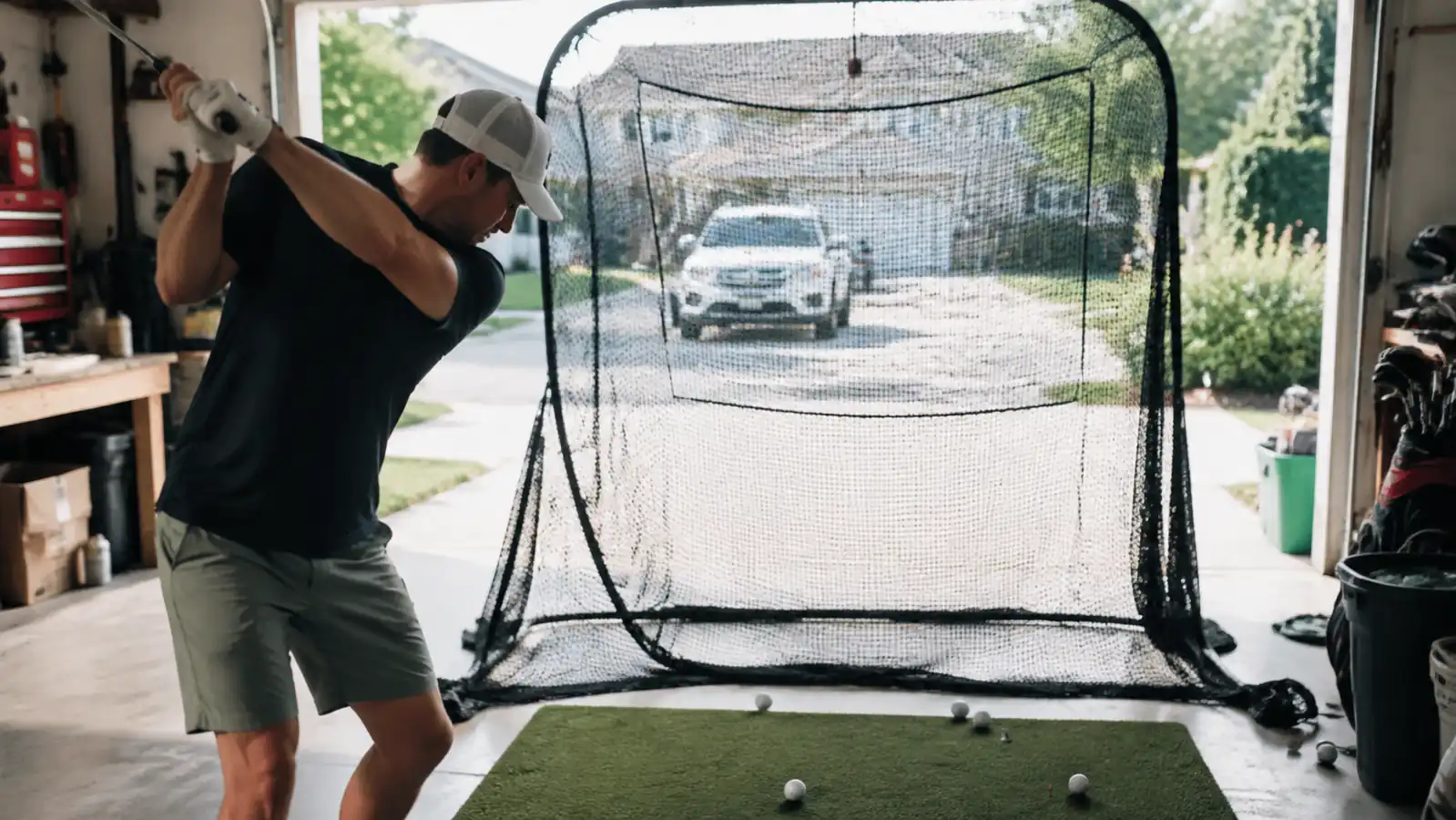
I put my golf net up on a Tuesday night in April because I was sick of hitting rubber-tee grounders in the yard at my buddy's place every Sunday and calling it practice. I'm about a 14 handicap, I get to a real range maybe once every couple weeks if the kids' schedules cooperate, and the honest truth is most of my bad habits get built in the gaps between range trips, not on the range itself. A net in the garage closes that gap. It doesn't replace real practice, but it lets me hit fifty balls on a Tuesday instead of zero.
I set mine up with a GoSports golf net, the 7x7 version, wedged into the back third of my garage. It's held up fine, but the net itself was never the hard part. The hard part was doing the setup the boring, careful way instead of the five-minute way, and I want to walk through it exactly how I do it now, including the mistakes that taught me to slow down.
None of this is complicated. It's mostly measuring twice, checking the same three things before every session, and being honest about what a fabric net can and can't stop. If you skip that part, you'll still get a working net for a week or two, right up until the swing you're not paying attention to.
Skip the range traffic and hit fifty balls before dinner.
The GoSports golf net sets up in about ten minutes and folds flat when you're done with it. Check today's price and see which size fits your garage or backyard.
Amazon Check Today's Price on Amazon →Step 1: Walk the space before you touch the net
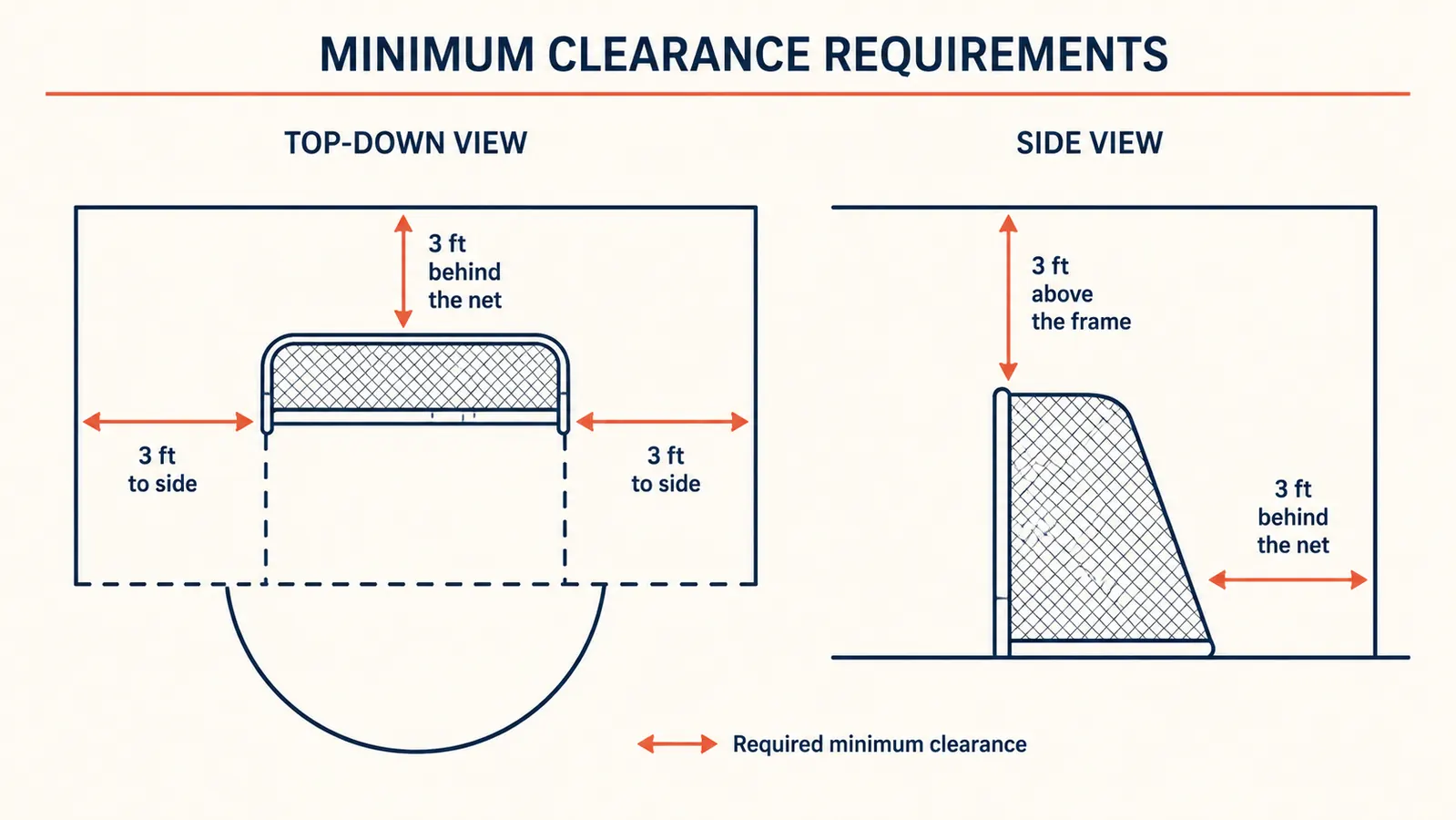
Before I unfolded anything, I walked the spot with a tape measure, which felt excessive until I remembered why I was doing it. My garage bay is about 20 feet deep. The 7x7 GoSports net needs roughly 10 to 12 feet of hitting distance in front of it to be useful for full swings, plus another 3 to 4 feet of dead space behind the net frame in case a mishit clips the edge and skips past. That leaves me maybe 4 to 6 feet behind my own setup position for a real backswing, which is tight but workable if I'm honest about only hitting three-quarter swings with mid-irons in there.
The number people skip is overhead clearance. A driver swing brings the clubhead up in an arc well above your own head height on both the backswing and the follow-through, and a garage with an 8-foot ceiling and exposed rafters will find that out for you fast. I keep the driver for the backyard, where I've got open sky, and I only hit wedges through 7-irons in the garage where the ceiling is a real limiter.
If you're setting up outside instead, walk the actual line the ball travels, not just the spot where the net sits. I've got a fence about 35 feet behind my net position and a neighbor's kitchen window well past that, and I still angle the whole setup slightly off that sightline out of habit. It's a golf net, not a cage, and a full swing with a mishit can still send a ball wide of the frame.
I also account for what's beside the setup, not just behind it. My side of the garage has a workbench about 6 feet off my left shoulder, which is close enough that a hooked shot could realistically reach it. I either move the bench a few sessions a year when I know I'll be working on my swing plane, or I hit from a stance angled slightly away from it. Either way, I checked it once with a tape measure instead of assuming it was fine.
Step 2: Anchor it before the first swing, not after a gust
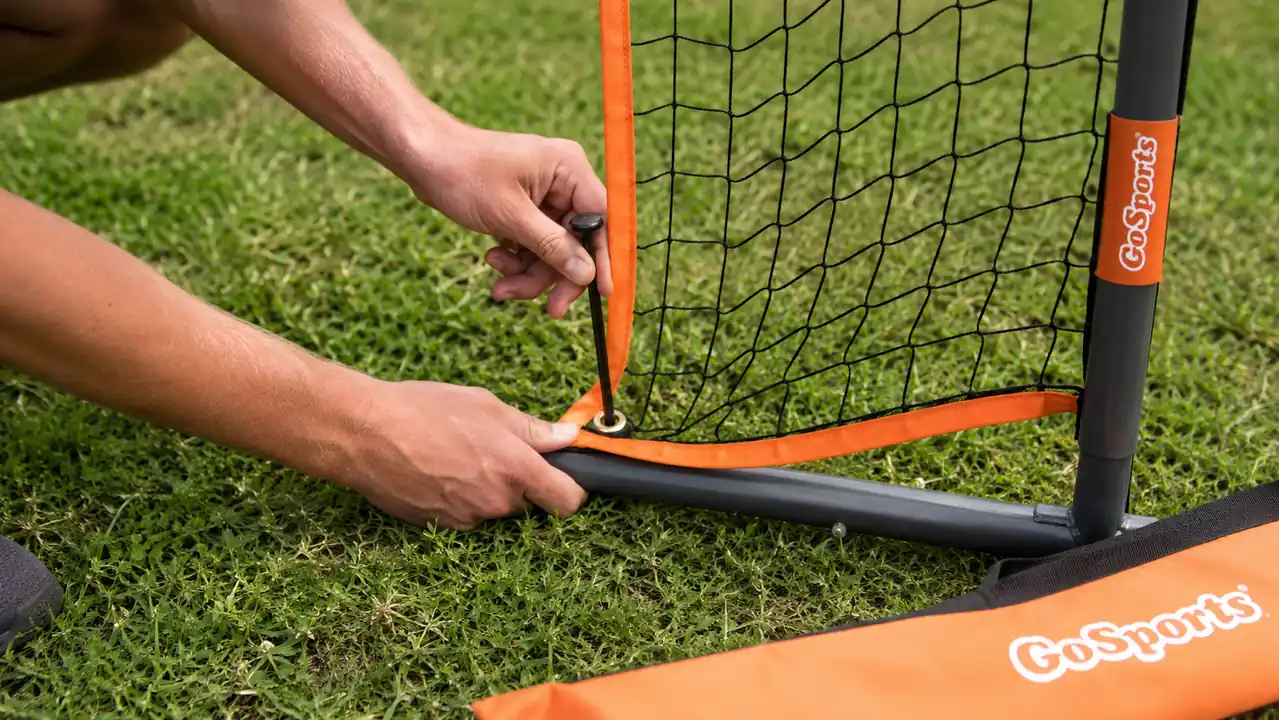
The first time I set the net up outside, I didn't stake it down because I figured the frame's own weight would hold. A gust caught it twenty minutes in and folded the whole thing sideways into my daughter's bike. Nothing broke, but it was a dumb way to learn the lesson. Now every leg gets a stake, and I add a sandbag or two at the base corners on days with real wind, which around here is most spring afternoons.
In the garage this isn't a wind problem, it's a tension problem. The frame needs to be pulled taut enough that the netting doesn't sag and let a ball drop weird off a low shot, but not so tight that you're fighting the poles every time you fold it down. I check the corner tension every few sessions, because the fiberglass rods do relax slightly over months of use and setup.
I also test the anchoring with a hand shove on the top frame before the first swing of any session, not just the first time I ever set it up. A stake can work loose over a few weeks of freeze and thaw in the yard, and it's a five-second check compared to chasing a tipped-over net across the lawn mid-swing.
Step 3: Set your hitting spot and distance, then don't guess at it
I use a thin rubber mat as my hitting station and I put it down first, then measure back from the net to figure out exactly where the mat goes, instead of eyeballing it. Too close to the net and low, thin shots can rebound back at your feet harder than you'd expect. Too far and you lose the sense of ball flight that makes the whole setup worth anything.
My mat sits about 9 feet from the net face in the garage, which is close to the minimum I'd recommend for a 7x7 net. If you've got the room for a 10x7 and more depth, back it up to 12 to 15 feet so you get a slightly truer look at trajectory before the ball disappears into the netting.
I also mark the tee position with a strip of tape on the mat so it's the same spot every session. It sounds minor, but consistent setup position is half of why the net actually improves anything. If you're standing somewhere different every time, you're not building a repeatable swing, you're just hitting balls into fabric.
Step 4: Pick the right ball for where you're hitting
This is the step people skip and then wonder why they've got a scuff mark on the drywall. My GoSports net has side barrier panels that catch most mishits, but a full-swing slice with a real ball can still find the gap between the barrier and the main net, especially with a longer club. In the garage, I hit limited-flight practice balls almost exclusively, the perforated plastic kind, because even a bad miss just doesn't carry enough energy to do damage.
Outside, where I've got more open space around the net, I'll use real range balls for wedge and short-iron work because I want the real feel and sound of contact. But once I move up to 7-iron and longer outside, I go back to limited-flight balls unless I've checked that there's nothing breakable within 40 feet of the net on any side.
Foam balls are the safest option of all three but they're honestly not worth much for feedback. I keep a dozen in the garage for when my youngest wants to take a few swings with me, but for real practice I'd rather deal with the small extra care that limited-flight balls require.
Step 5: Run the same check before every session
Before I hit a single ball now, I do a 30-second walk of the net: check the four stakes or corner weights are still seated, run a hand along the bottom seam for any tear starting, and glance behind the net for anything that's wandered into the landing zone, which around my house usually means a kid's scooter or the dog. It takes less time than it took me to write this sentence and it's caught a problem twice.
The other habit worth building is standing where you're supposed to stand and staying there. I've been tempted to inch closer to save a few steps walking to retrieve balls, and every time I do, the margin for a bad bounce back at me gets smaller. The net does its job. Let it.
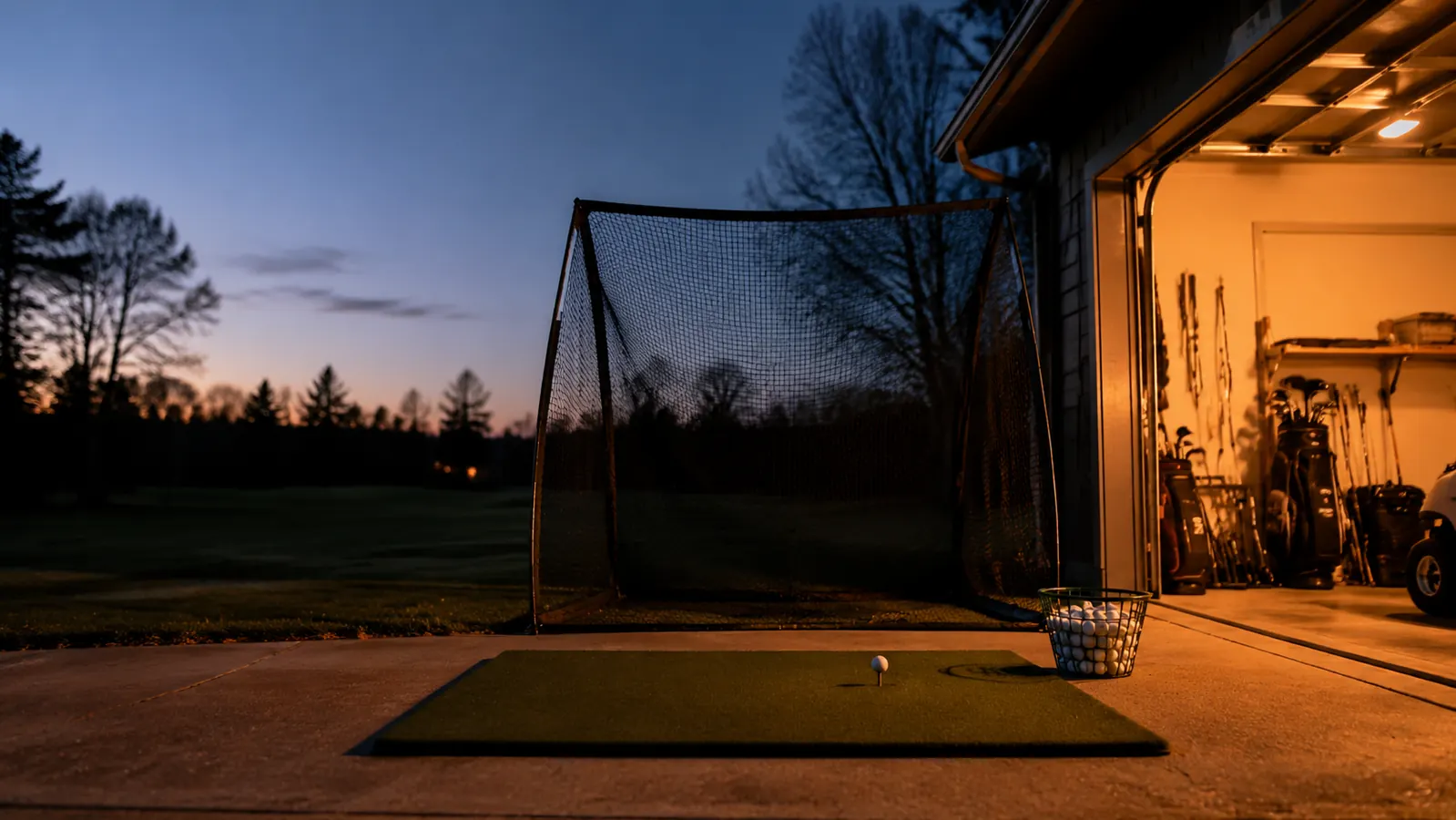
I also stop for the day the moment the light gets bad, especially outside. It's easy to keep hitting when you can still sort of see the net, and that's exactly when a stray shot toward the fence or a window is more likely, because you're guessing at the ball flight instead of watching it. A backyard net earns its keep in daylight and under a garage light, not at dusk when you're squinting.
What I Liked
- Turns dead garage or yard space into real practice time
- Folds flat for storage between sessions
- Side barrier panels catch most mishits
- Cheap enough that the payoff is a few range trips, not a season
Where It Falls Short
- Overhead clearance in a garage limits you to shorter clubs
- Real balls can still escape on a bad full-swing miss
- Netting needs periodic tension checks
- Not a substitute for a real launch monitor if you want exact numbers
What Else Helps
A thin rubber mat and a couple of alignment sticks do more for the quality of your reps than any upgrade to the net itself. The mat protects your turf or garage floor and gives you a consistent lie, and the sticks laid down at your feet and toe line catch alignment problems that a net alone will never show you, since the net doesn't care if you're aimed 15 degrees off. I'd get those two things before I'd spend money on anything fancier.
A cheap shag bag or a bucket with a wide mouth also matters more than it sounds like it should. Bending over to pick up fifty balls by hand after every session is the kind of small friction that quietly kills the habit after a few weeks. Make it easy to reset the station and you'll actually use the net through the winter instead of once in April.
The net doesn't fix your swing. It just gives you enough reps that you stop guessing what your swing actually does.
Ten minutes of setup buys you a season of extra reps.
If your practice time keeps losing to a full calendar, a net in the garage or backyard is the cheapest fix I've found. See current sizing and price on the GoSports net.
Amazon Check Today's Price on Amazon →