

Short answer up front: if you're a weekend golfer who wants a net that goes up in about five minutes and comes back down just as fast, the GoSports Golf Practice Hitting Net is the one I'd point you to, and it's the one that's been living against the back wall of my garage since last November. The Rukket Haack Attack Net is the one you buy when you've got a dedicated space, a bigger budget, and you're hitting full driver swings every single night instead of the occasional wedge session after work. Both nets do the basic job of catching a golf ball without putting a dent in your garage door, but they're built for two different kinds of practice habits, and mixing that up is how people end up disappointed with either one no matter how many stars it has on Amazon.
I've put somewhere north of 4,000 balls into my GoSports 10x7 since I set it up, mostly 9-iron and wedge work on weeknights when the course is dark by 5:30 and my clubs would otherwise sit in the trunk until spring. A buddy of mine two streets over runs the Rukket Haack Attack in his basement and swings driver into it nearly every day, sometimes with his older kid shagging balls for him on the weekend. We compared notes over a beer in February, and the honest answer is neither of us would trade nets with the other. He needs something that can absorb a 105 mile-an-hour clubhead speed forever. I need something that gets out of my wife's way when she pulls the car in, and that difference is really the whole point of this comparison.
Before we get into the table, it's worth saying plainly that these two nets aren't really competing for the same buyer, even though they show up next to each other in every search for a golf practice net. One is a portable practice aid you pull out a few nights a week and put away just as fast. The other is closer to a piece of home gym equipment that happens to be for golf, the kind of thing you build a corner of a basement around and never move again. Judging either one against the other's strengths is how you end up with a review that tells you nothing useful, so I've tried to keep this to what each net is actually good at, not which one wins on paper, and not which one has the flashier marketing photos.
It also helps to think about what either net actually replaces. A season of range balls and drive-time to the course adds up fast if you're hitting more than a bucket or two a week, and neither of these nets is trying to be a full driving range or a swing lab. What they're both trying to do is turn five or ten spare minutes on a weeknight into real swing reps instead of zero reps, which is the actual gap most weekend golfers are trying to close between rounds, whether they'd put it that way or not.
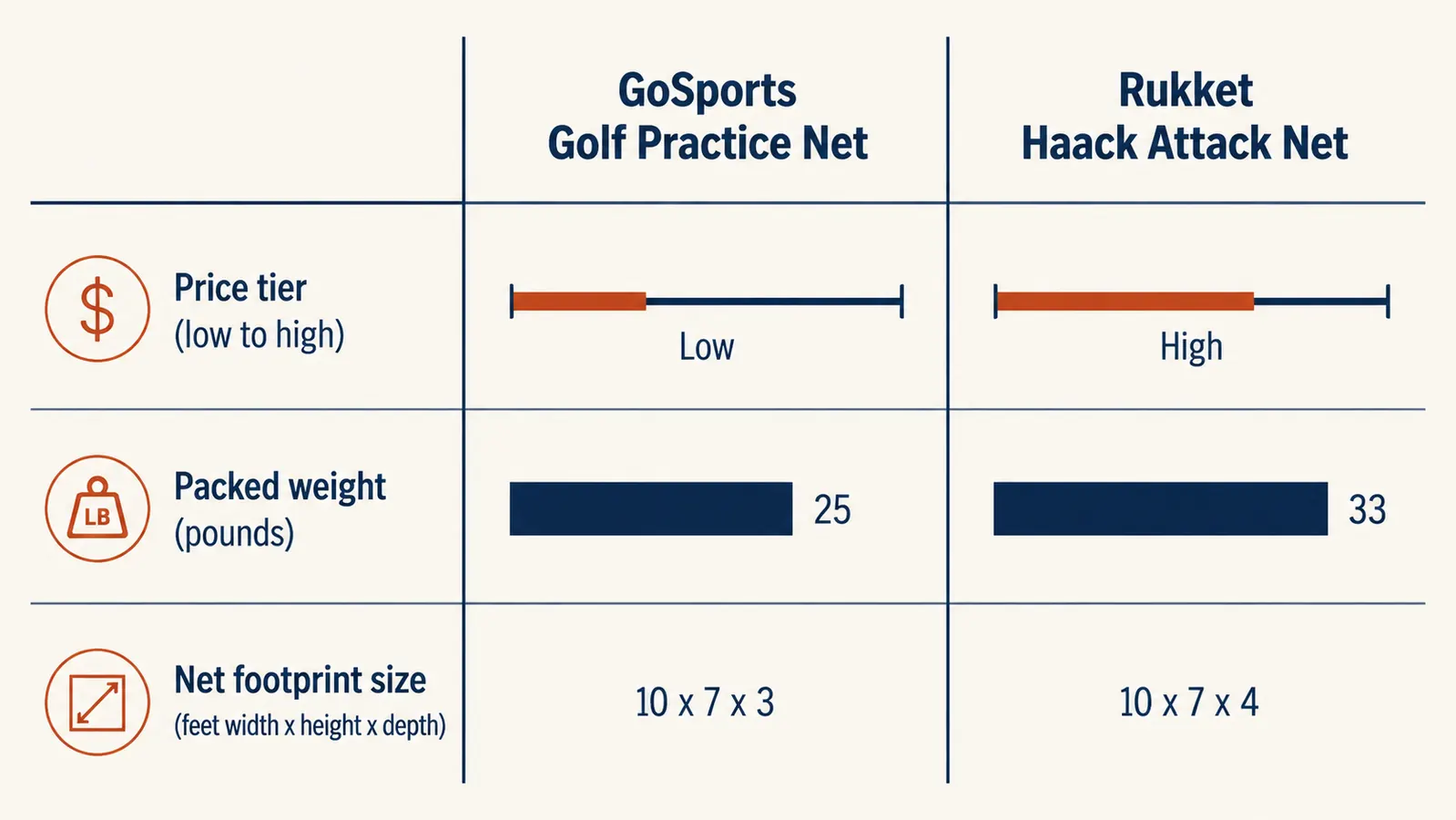
| GoSports Golf Net | Rukket Haack Attack | |
|---|---|---|
| Current Price Tier | Budget friendly, well under $100 | Noticeably higher, often close to double the GoSports price |
| Net Size Options | 7x7 ft or 10x7 ft | Larger single footprint built around full swings |
| Frame Material | Fiberglass poles with quick-connect joints | Heavy-gauge steel poles |
| Solo Setup Time | About 5 minutes | 10 to 15 minutes, more poles to thread and lock |
| Packed Weight | About 13 lbs, fits in the included carry bag | 35+ lbs, not really a grab-and-go net |
| Ball Containment | Solid netting, occasional roll-back on hard shots | Deeper netting plus a target sheet, stops full drivers cold |
| Included Accessories | Target sheet and carry bag, mat sold separately | Target sheet, tee, and a heavier anchor kit |
Where GoSports Wins
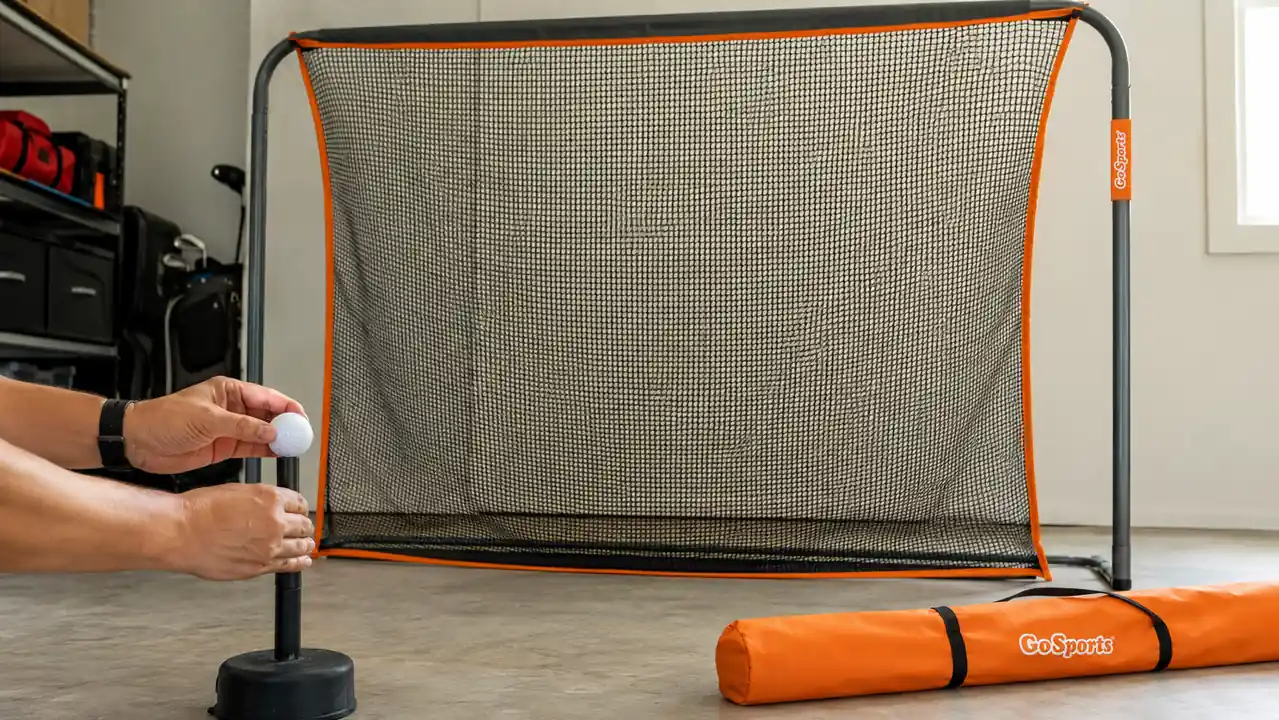
The GoSports net earns its spot in my garage for one reason: it disappears the moment I need my garage back. Five minutes to set up before I hit a bucket of wedges after dinner, five minutes to break it down and lean it against the wall before my wife needs to park the car in there. The fiberglass poles are lighter than they look, the quick-connect joints don't require any tools, and the whole thing packs down into a carry bag that weighs about what a stand golf bag does. For anyone working with a two-car garage, a basement with a furnace taking up a corner, or a driveway that also has to function as an actual driveway on trash day, that portability matters more than raw containment ever will. I've genuinely never once looked at the setup process and thought about skipping a practice session because of it, which is more than I can say for some of the gear collecting dust in my garage right now.
It's also the smarter first purchase for anyone testing whether they'll actually use a net at all before spending more money on the hobby. At a price well under what the Rukket runs, it's a low-risk way to find out if hitting into mesh three nights a week actually changes your ball-striking, without having to spend Rukket money to learn the answer. I've caught the frame with a shanked 7-iron more times than I'd like to admit over four months of near-daily use, and it has never buckled, bent, or gone out of square on me. For a net in this price range, that kind of frame integrity is not something I expected going in, and it's the main reason I've kept recommending it to guys at my club who ask what I use to stay sharp in the off-season.
The two-size option is worth a mention too. My garage only had room for the 7x7, and it's still plenty of net for irons and wedges from a normal hitting distance, roughly the gap between my mat and the far wall. If you've got a bigger space, the 10x7 buys you more margin for a mishit that starts leaking left or right, without changing anything else about how the net sets up, folds down, or fits back in its bag.
Where Rukket Haack Attack Wins
Where the Rukket pulls ahead is anywhere a full swing is involved. My buddy swings driver into his almost every night, and the deeper netting plus the target sheet actually stop the ball dead instead of letting it roll back six feet the way mine sometimes does on a mishit. The steel frame he's got doesn't flex the way my fiberglass poles do when a ball catches a pole instead of the netting, which happens more with a driver in hand than either of us likes to admit. He's also hit it with a genuinely bad shank, the kind that would've put a dent in drywall, and the frame absorbed it without shifting an inch off its footprint, which is more than I can say for how mine reacts to the same kind of miss.
The best net is the one you'll actually set back up next Tuesday, not the one that looked toughest in the box.
The tradeoff is space and mass. His setup lives permanently in one corner of a finished basement, because moving 35-plus pounds of steel poles in and out isn't a chore he's willing to take on every night after work. If you've got a dedicated hitting space and you're not folding the net up between sessions, that extra weight and size stop being a downside and just become the cost of owning a net that can take real driver swings for years without complaint. The heavier anchor kit that comes with it is also worth mentioning. He's never had it walk forward on a hard hit the way lighter nets sometimes do over time, and after more than a year of near-daily use, the netting itself still shows almost no fraying at the seams.
If you're paying full price for the extra size and steel, it's fair to expect that kind of longevity out of it. A net that lives in one spot and gets swung at hard every day needs to earn its higher price back over a couple of seasons, and from what my buddy has seen so far, it's on pace to do exactly that, without a single repair or replacement part so far.
Your Swing Doesn't Take the Winter Off. Why Should You?
If you're working with a garage, a driveway, or a basement corner you need back most nights, the GoSports net folds down in the time it takes to change your shoes. See today's price and current availability on Amazon.
Amazon Check Today's Price on Amazon →
Who Should Buy Which
If your practice sessions are mostly wedges, mid-irons, and the occasional full swing, and your net has to live somewhere that also has to be usable for other things, like a shared garage, a spare bedroom, or a driveway, the GoSports is the right call. It's cheaper, it's lighter, and it's the one you'll actually keep setting up because it costs you almost nothing in time or floor space. It's also the better pick for a parent buying a first net for a kid who's just getting into the game, since the lower price and easy setup make it easy to justify before you know how much use it'll actually get, and easy to hand down or replace later without much regret either way.
If you're hammering driver into a net every night, you've got a permanent spot for it, and you'd rather pay once for something that shrugs off years of full swings without a second thought, the Rukket Haack Attack earns its higher price. The bigger footprint and deeper containment are built for exactly that kind of daily punishment, and the steel frame will outlast a lot of the golfer's other gear along the way. Neither golfer here is wrong. They're just solving a different problem, and the honest move is to buy for the practice habit you actually have right now, not the one you imagine you'll build once you own the fancier net.
If you're genuinely torn between the two, ask yourself how the net will actually get used on a Tuesday in February. If the honest answer involves clearing space and putting it back before bed, buy the one that makes that easy. If the answer is a permanent setup you walk down to every night after the kids are in bed, the bigger, sturdier net starts to make a lot more sense, and the extra cost stops feeling like a splurge and starts feeling like the obvious call.
Five Minutes to Set Up, Five Minutes to Put Away
That's the whole pitch for the GoSports net. Check current pricing and see why it's one of the most reviewed practice nets on Amazon.
Amazon Check Today's Price on Amazon →