
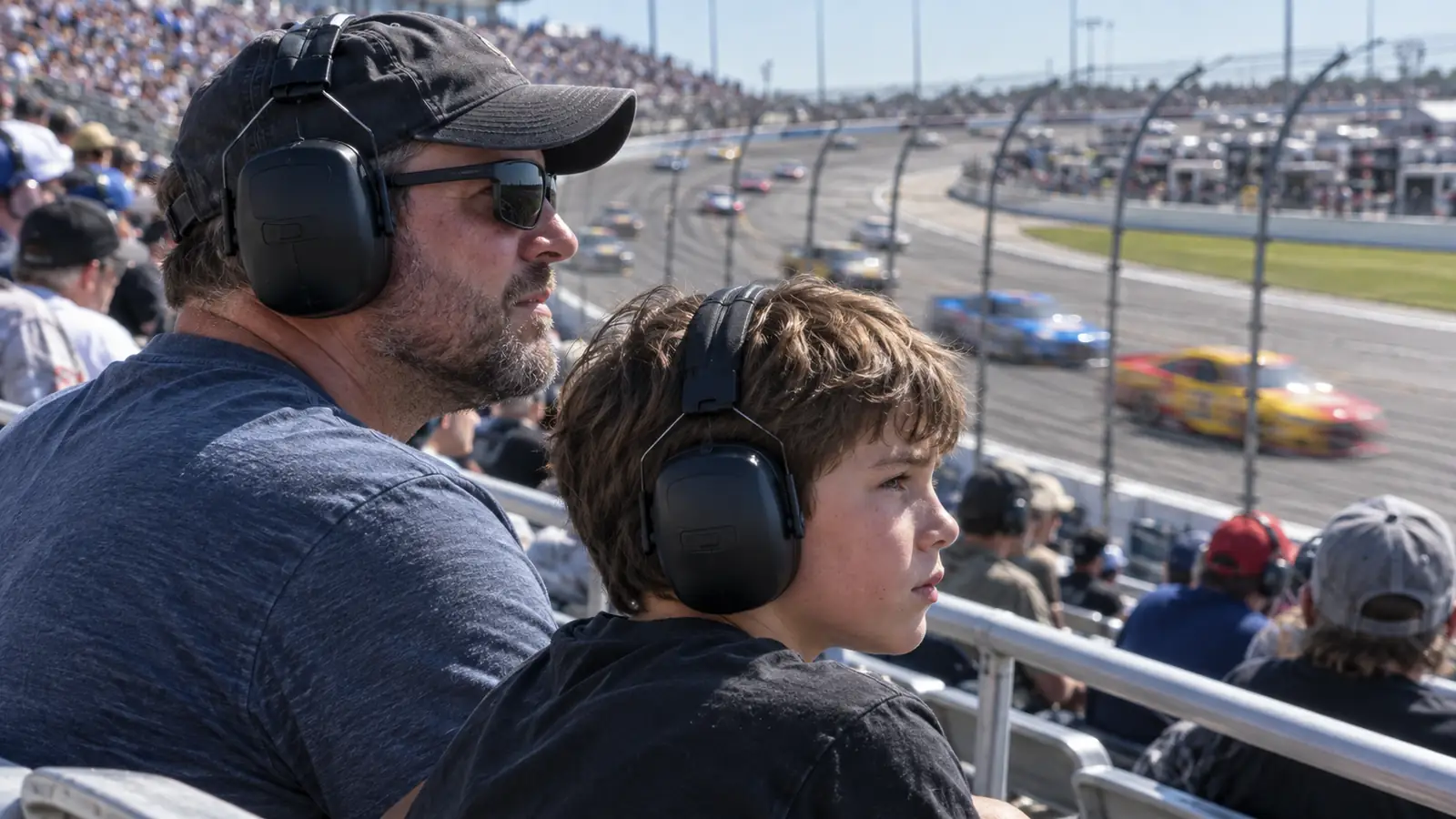
The first time I brought my son Cole to a Cup race, he spent the opening laps wincing with his hands half over the free foam plugs they hand out at the gate. I dug a spare pair of electronic earmuffs out of my bag, showed him the volume dial, and by turn four he'd forgotten they were even on. He's worn a pair to every race since, and so have I. I've spent this past season wearing the Peltor Sport Tactical 500 to five race weekends, three Cup races and two nights at our local short track, and this is the honest case for why electronic earmuffs belong in every race fan's bag, not just the diehards who show up every single weekend.
This isn't a full review, I've written that one separately. This is just the ten reasons, roughly in the order they actually come up at a track, that a pair of electronic earmuffs earns its spot over a pocketful of free foam plugs.
Still fumbling with foam plugs between cautions?
The Peltor Sport Tactical 500 electronic earmuffs let ambient sound and Bluetooth audio through without you ever pulling anything off your head. Check today's price and current stock on Amazon before your next race weekend.
Amazon Check Today's Price on Amazon →You can actually hear the scanner or the broadcast
Foam plugs are all or nothing. Once they're in, you're not hearing a race scanner app, a spotter's call, or anything else beyond a muffled roar. The Peltor Sport Tactical 500 pairs over Bluetooth, so I can run a scanner app in one ear and still get the ambient track sound mixed in at a lower volume. That mix is the whole point of electronic earmuffs over a passive pair, you're not choosing between blocked out and blasted, you get both at a level you actually pick.
You can talk to the person next to you
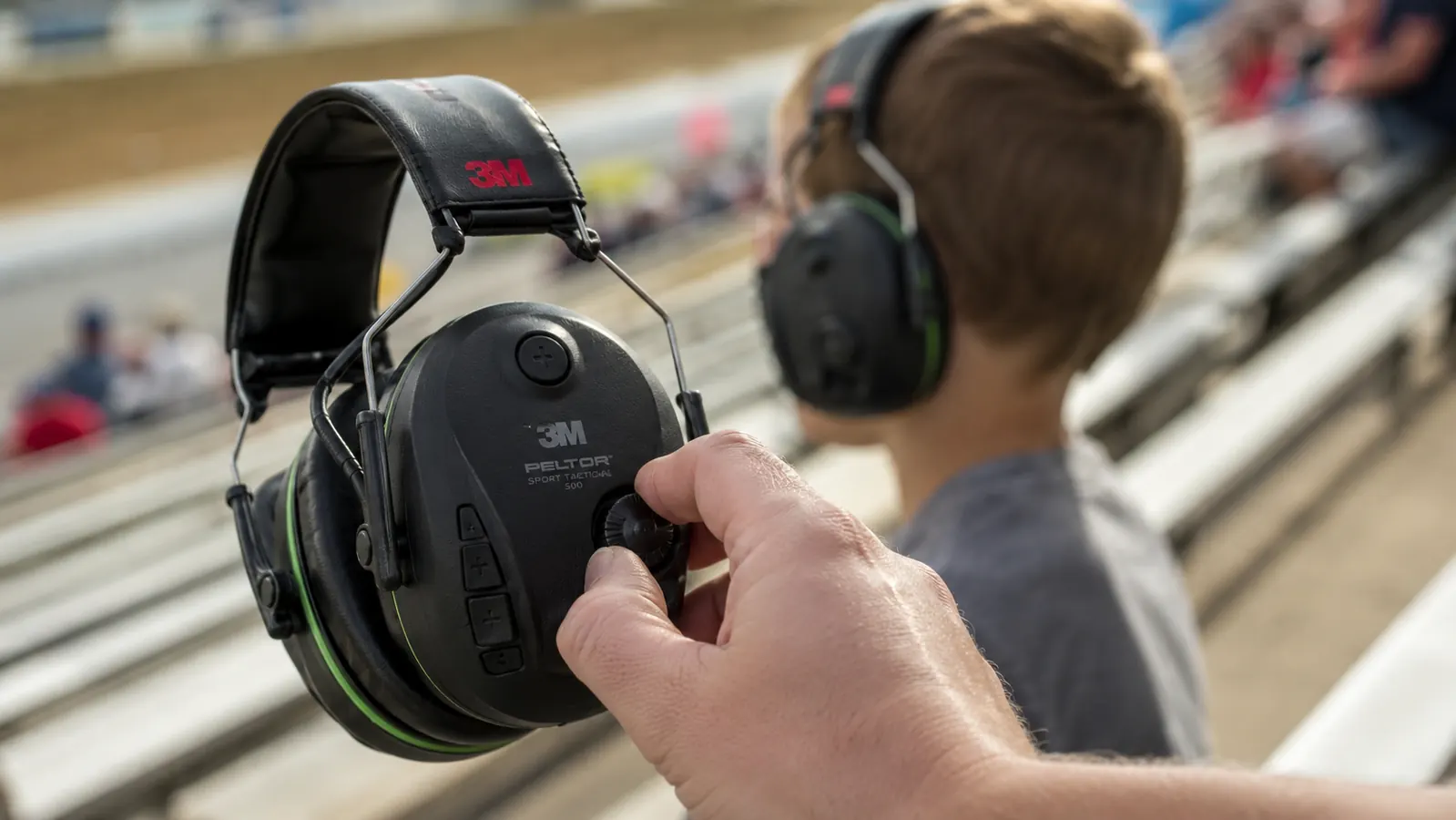
This is the reason I'd point to first if someone asked me why I bother. Cole sits next to me most race weekends, and with plain foam plugs in, any conversation meant taking one out, leaning in, and shouting anyway. With the electronic earmuffs on, the built-in microphones pick up his voice at normal volume even with the engines running behind us. We talk through most of a race now the same way we'd talk on the drive there.
They stay comfortable for a full nine-hour day
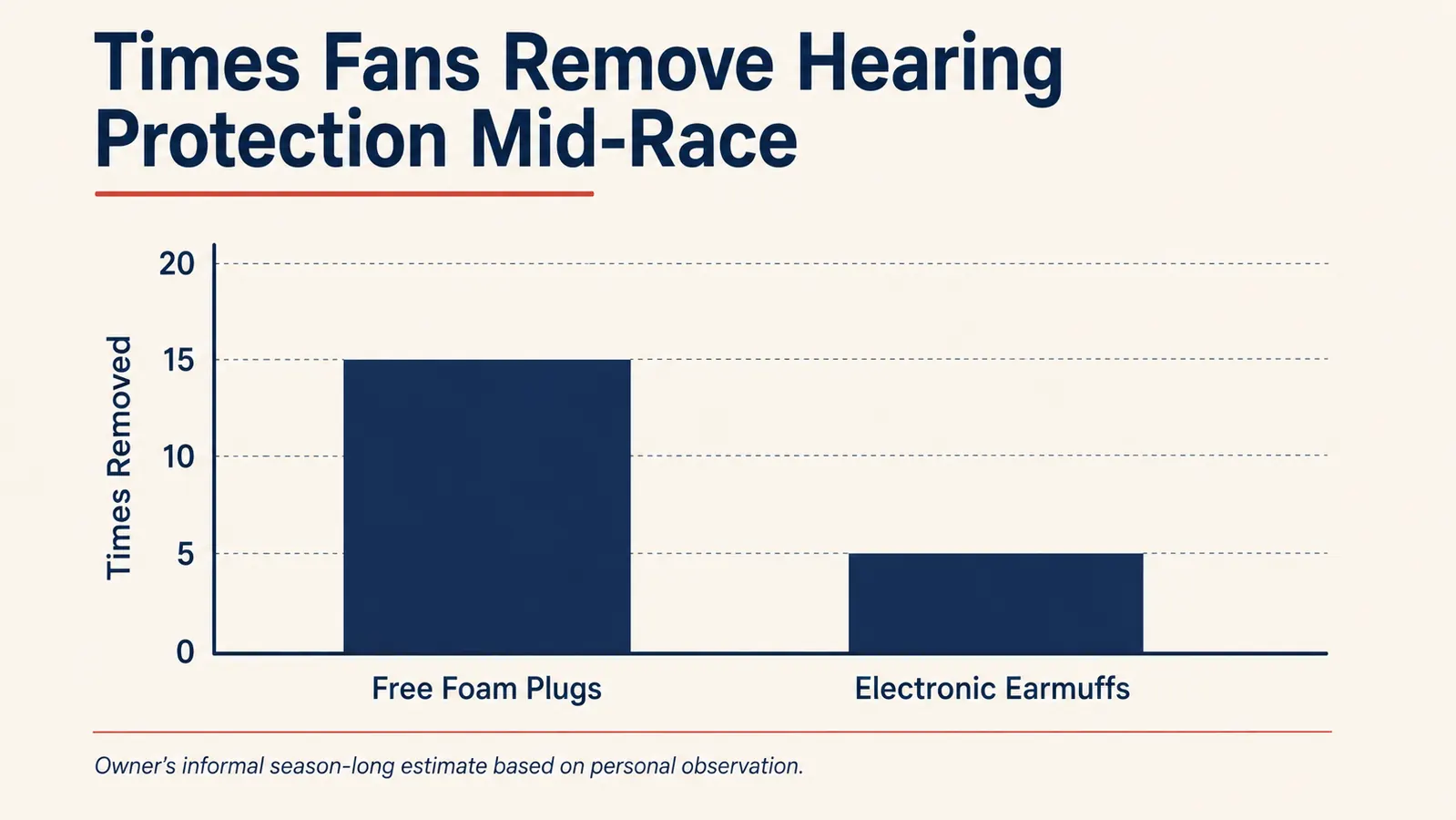
A Cup weekend runs practice, qualifying, and a race that can stretch past sunset, which adds up to most of a day with something clamped on your head. Foam plugs get uncomfortable fast if you're pushing them in and out all afternoon, and a cheap passive muff tends to loosen and let noise creep back in by the last hour. The clamping force on the Tactical 500 stayed consistent through every one of my five race weekends, right when the grandstand usually gets loudest anyway.
Battery life that outlasts the whole weekend
The Tactical 500 runs on two AA batteries instead of a proprietary rechargeable pack, and Peltor's own spec sheet claims around ten and a half hours of run time with Bluetooth active. Across the season that tracked close to what I actually got. I keep a spare set in the truck console now, the same way I keep spares for a garage remote, and the automatic shutoff after four hours of no button presses has saved me from an accidental drain more than once.
They fit fine under a cap and work for growing kids
I wear a ball cap most race days, and the headband works fine if you push the brim back slightly to clear it. Cole was eleven the first time he wore an adult-sized pair for a couple of hours at the short track, and the headband adjusted down small enough to seal properly on him. That matters if you've got a kid who's outgrown a dedicated kids' set but isn't quite ready to just have the free plugs and nothing else.
The volume dial gives you real control, not just on or off
Foam plugs and cheap passive muffs are one setting, whatever level of muffled you get is what you're stuck with for the day. Electronic earmuffs let you dial ambient amplification up during a quiet caution lap and back down when the field takes the green flag. I ride that dial constantly through a race, turning it up to catch what a spotter's saying and back down before the next restart.
One pair earns its keep well past race day
Peltor markets this same pair for shooting, hunting, mowing, and construction just as much as motorsports, and I've worn mine trimming the yard on a handful of Saturdays to see if the electronics held up outside a stadium setting. They did. A pair that only comes out of the bag five or six times a season for races is a harder buy to justify than one that also handles the lawn mower and the leaf blower the rest of the year.
They hold up race after race without falling apart
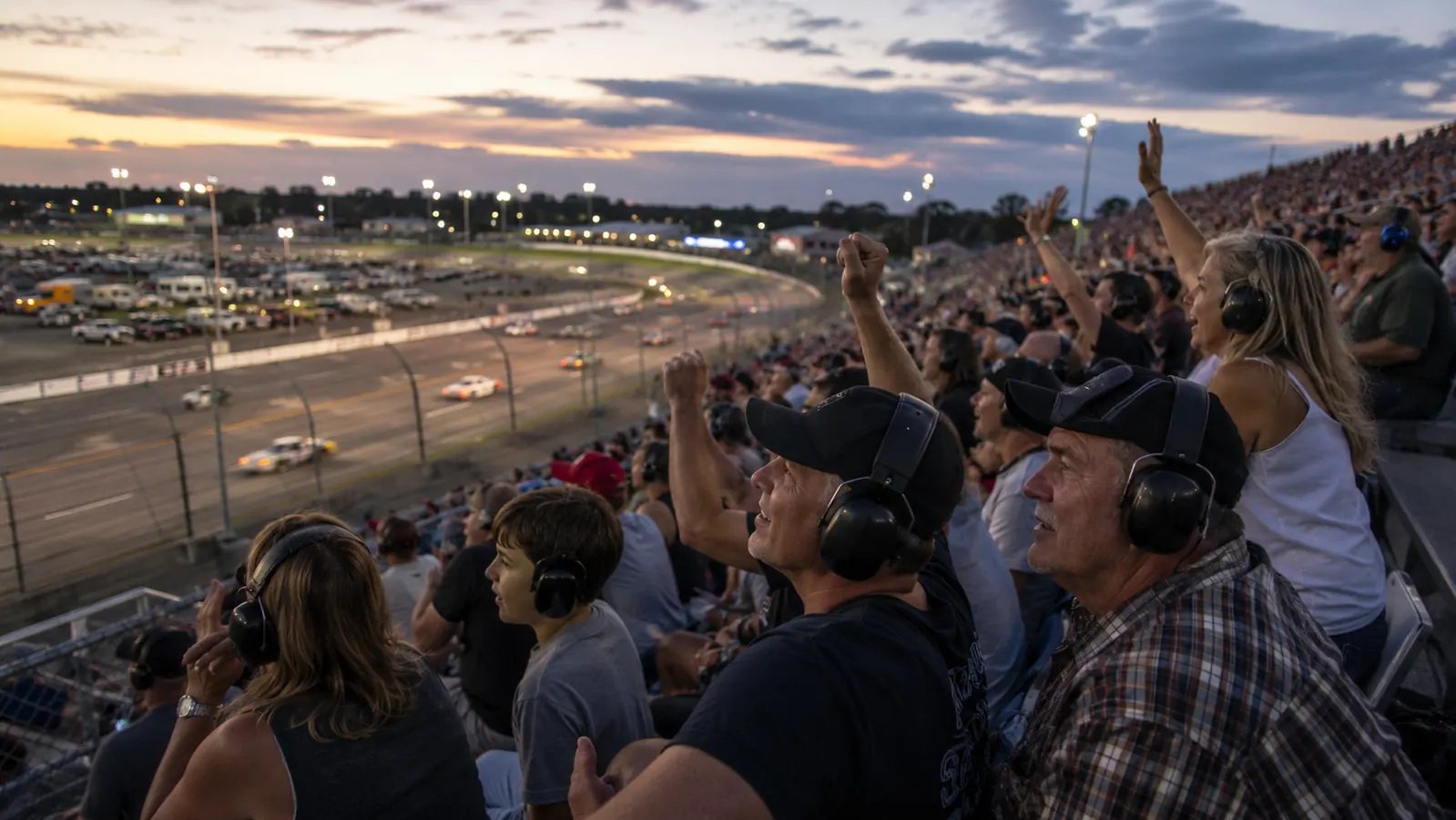
A pair of electronic earmuffs that dies mid-season or cracks after a few drops on the pavement isn't worth carrying. Mine has ridden in the same bag pocket since spring, through a three-day Cup weekend that ran from a cool morning practice into full sun by qualifying and then under the lights past sunset, roughly nine hours of on-and-off wear stacked on two practice days before it. The hinges and headband still hold their tension the same as day one.
They're a better first upgrade than earbuds
I've seen plenty of fans try to solve the noise problem with earbuds and a music app, which does nothing for the engine roar and just adds more sound on top of it. Electronic earmuffs actually address the problem instead of layering another audio source over it. When Cole wanted to bring his phone to a race, I handed him the earmuffs with Bluetooth paired instead, and he got music between cautions and could still hear me talk without a single earbud falling out.
They pay for themselves against buying cheap ones every season
I went through two different bargain passive muffs before I bought the Tactical 500, one with a headband that snapped by midseason and another with foam that flattened out after a handful of uses. Replacing a cheap pair every year or two adds up fast, and none of those replacements ever gave me the Bluetooth or the amplification control that made the upgrade worth it in the first place. Buying once and keeping it all season has been the cheaper move by the numbers.
What I'd Skip
I'd skip any electronic earmuff that doesn't let you adjust ambient volume separately from whatever it's streaming, since a single dial for both just means compromising on each at once. I'd also skip buying a pair right before a big race weekend without testing the fit and the buttons at home first, since fumbling with a new pairing menu at the gate wastes the first twenty minutes you're there. If you want the full breakdown of specs and price ranges before you buy, our full buying guide for race-day hearing protection covers that in more detail, and if you want the season-long durability story on the exact pair I wear, read our long-term Peltor review.
I didn't buy electronic earmuffs to hear less at a race. I bought them to finally hear the things I actually wanted to hear.
Ready to hear the race instead of just surviving it?
The Peltor Sport Tactical 500 is the pair I've worn all season, gate to checkered flag. Check today's price before your next race weekend.
Amazon Check Today's Price on Amazon →