
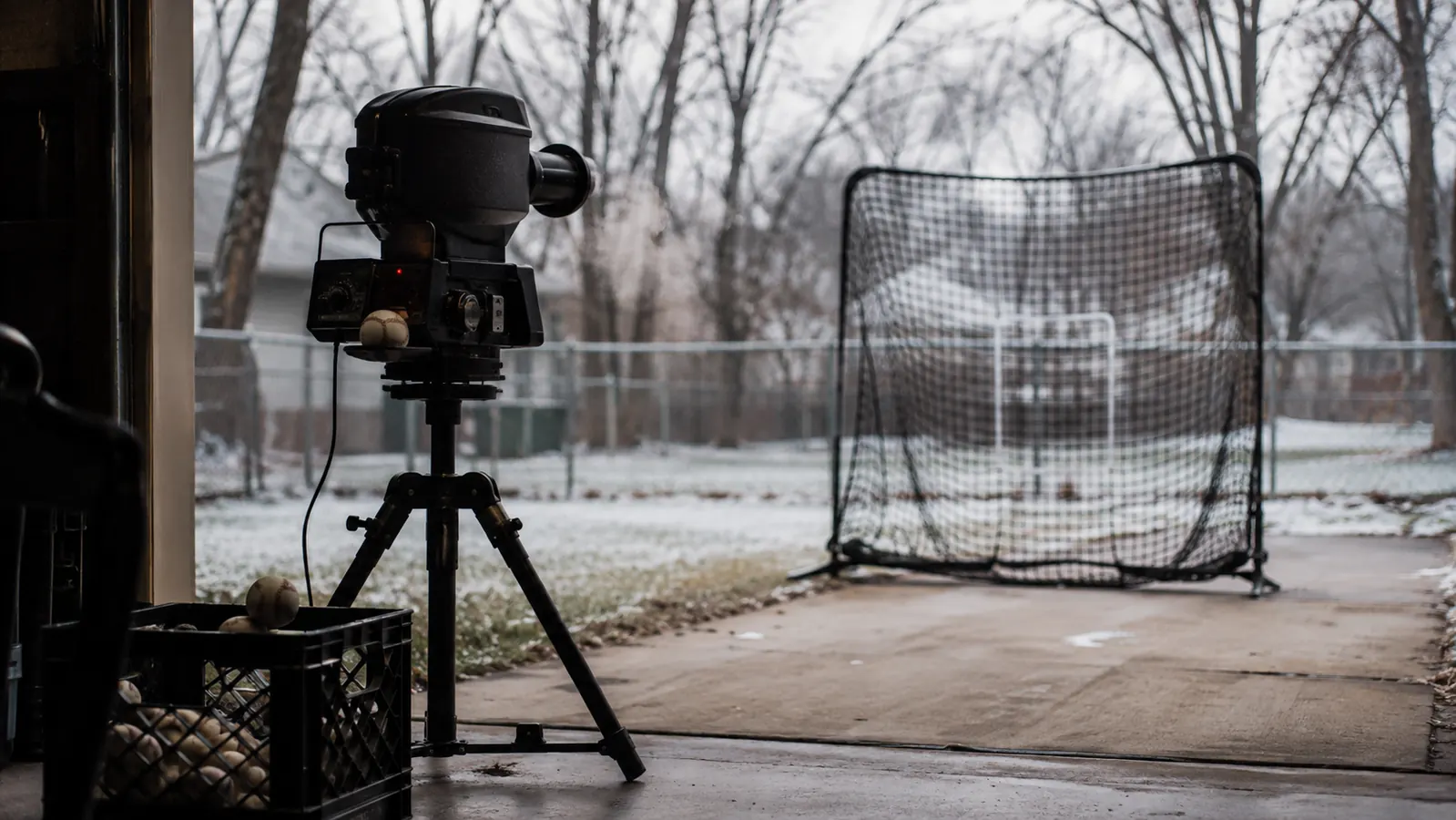
I want to start with the thing nobody selling the Louisville Slugger Blue Flame pitching machine tells you upfront: the number on the box and the weight you actually feel once it's assembled and loaded with balls are not the same number, and that gap is the first honest lesson this machine teaches you before it throws a single pitch. I bought ours in early September, right as my daughter Rowan's fall softball season kicked off, and we've run it out of our garage onto the driveway most weeks since, straight through a cold stretch of winter this machine was never really marketed for. Twenty-eight sessions and something north of a thousand pitches later, I like this machine overall. I also think a handful of things about it deserve to be said plainly instead of buried under a five-star headline.
Rowan is 13, plays third base and some catcher for a travel softball team, and hits right-handed. The pitching she sees in games is windmill fastpitch, underhand with real rise and drop on it, and no backyard machine at this price point throws that motion. I bought the Louisville Slugger Blue Flame anyway, mostly so she could get reps tracking a consistent pitch and grooving her timing on contact, not to simulate a live fastpitch pitcher's release. That distinction matters enough that I'm putting it in the second paragraph instead of burying it, because it shapes almost everything else in this review.
The Quick Verdict
A solid, honest value for repeatable overhand-style batting practice, but the real carry weight, cold-weather quirks, and the overhand-versus-windmill mismatch for fastpitch hitters deserve more attention than most reviews give them.
Amazon Check Today's Price →Nobody mentions the weight until you're the one carrying it across a frozen driveway.
We'll cover exactly what surprised us below, but the short version is that this machine still earns its spot in our garage every week. Check today's price and current stock on Amazon before you decide.
Amazon Check Today's Price on Amazon →How I've Used It
Our setup is different from a lot of the reviews I read before buying. We keep the machine just inside the garage door, plugged into an outlet on the garage wall so there's no extension cord running across wet pavement, and we angle it out toward a portable net we already owned, set up against the chain-link fence at the end of our driveway. That gave us a fixed, repeatable spot from day one, no trial and error finding the right patch of yard. What we didn't account for was weather. Fall ball ran into late October, and by November we were doing sessions in temperatures that hovered in the 30s and 40s, sometimes with the garage door only halfway up to cut the wind.
We've kept a rough session log on the fridge, mostly out of habit from tracking Rowan's other training, and it shows 28 sessions between early September and the end of February, averaging maybe 35 to 40 pitches each once you count warmup tosses and the occasional jam or misfeed we had to clear. That puts total pitches somewhere over a thousand, spread across a real range of weather rather than five months of consistent spring and summer conditions. I think that range is actually more useful information for a lot of buyers than a purely warm-weather season, because plenty of us are trying to keep a kid's swing sharp through the off-season, not just during it. December and January were the leanest months, maybe two sessions a month instead of our usual weekly rhythm, simply because between school nights, holidays, and a run of genuinely miserable weather, getting out to the garage stopped feeling worth it some weeks.
Speed-wise, we run Rowan's sessions in the low 30s up through about 42 depending on how the dial happens to land that day, and I've pushed it up into the high 50s a few times for my own cuts on weekend mornings when I wanted contact work before a men's league game. Those numbers land in a similar range to what most reviews report, so speed itself isn't where this review differs. It's everything around the pitching that surprised me.
The Weight Nobody Mentions
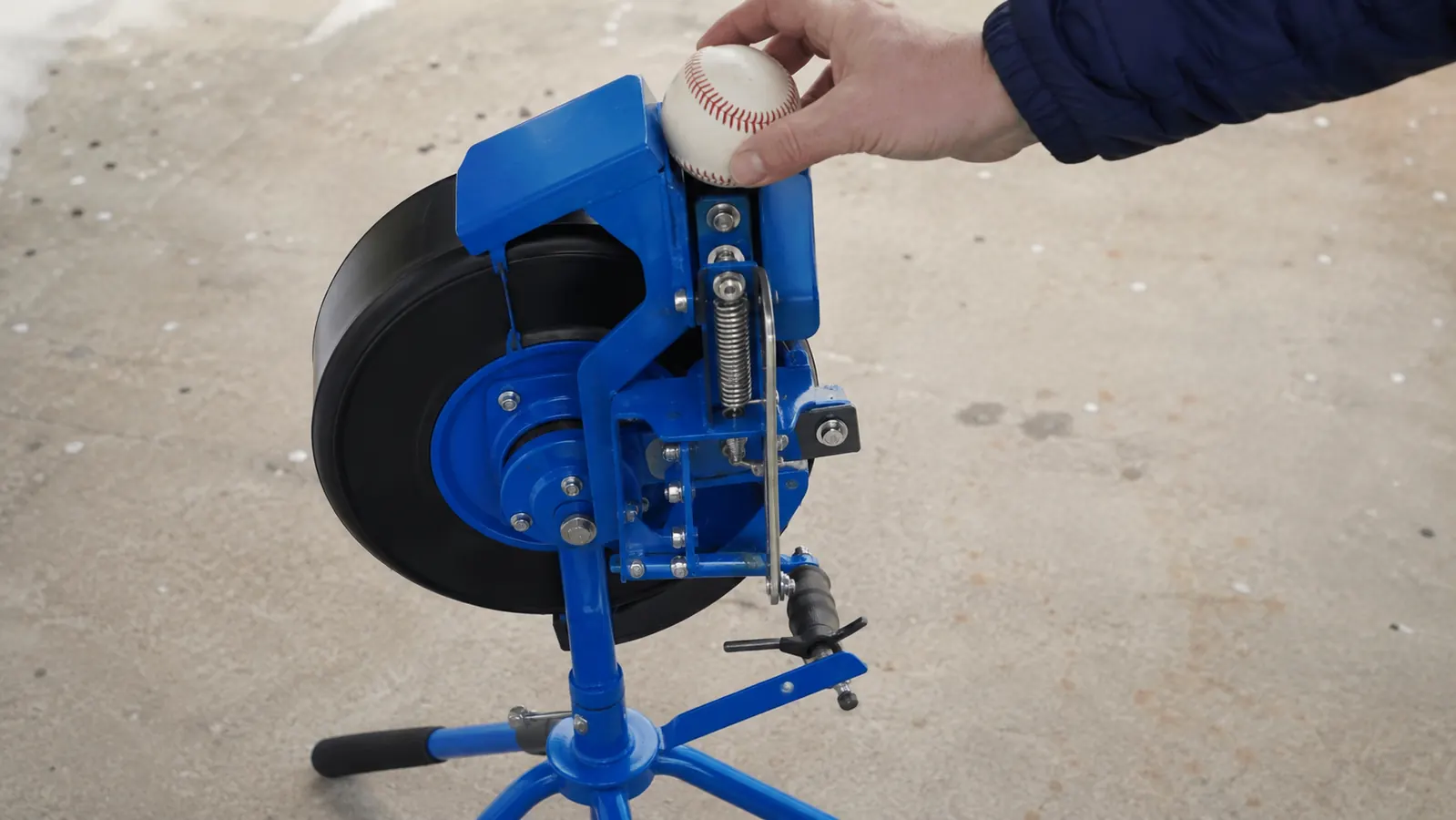
The listed weight for the fully assembled unit reads light on paper, and it is light compared to a real batting cage machine. What the spec sheet doesn't tell you is how that weight is distributed. The motor housing and wheel assembly sit high on the tripod, and once you've got a full hopper of balls loaded and the legs extended to hitting height, the whole thing feels top-heavy in a way a single weight number doesn't capture. Carrying it fully assembled from the garage corner to its spot takes two hands and some care, not the one-armed carry the marketing photos suggest.
This became a real issue in December when the driveway had a thin layer of ice near the garage threshold. Setting the machine down on an uneven or slick surface without both hands free and your footing solid is a genuinely bad idea, both for the machine and for whoever's carrying it. We solved it by keeping the machine assembled and stored just inside the garage door all winter rather than breaking it down after every session, which meant less carrying overall but ate up floor space we'd rather have used for something else. If you're buying this expecting to tuck it into a hall closet between uses, plan for more storage footprint than the box suggests. My spouse, who's smaller than I am, also tried carrying it solo a couple of times early on and asked me to just handle that part going forward, which tells you something the weight number alone doesn't.
What Cold Weather Actually Does to It
This is the section I haven't seen covered anywhere else, probably because most people buy this machine for spring and summer use. Once outdoor temperatures dropped into the 30s, we started noticing occasional hesitation in the feed cycle, a ball would sit at the top of the hopper a half second longer than usual before the wheel grabbed it, and a couple of times in our coldest sessions it double-fed, sending two balls through close together. It never damaged anything and it wasn't constant, maybe once or twice a session on our coldest days, but it's a real quirk worth knowing about if your off-season plans involve a garage or driveway rather than an indoor cage.
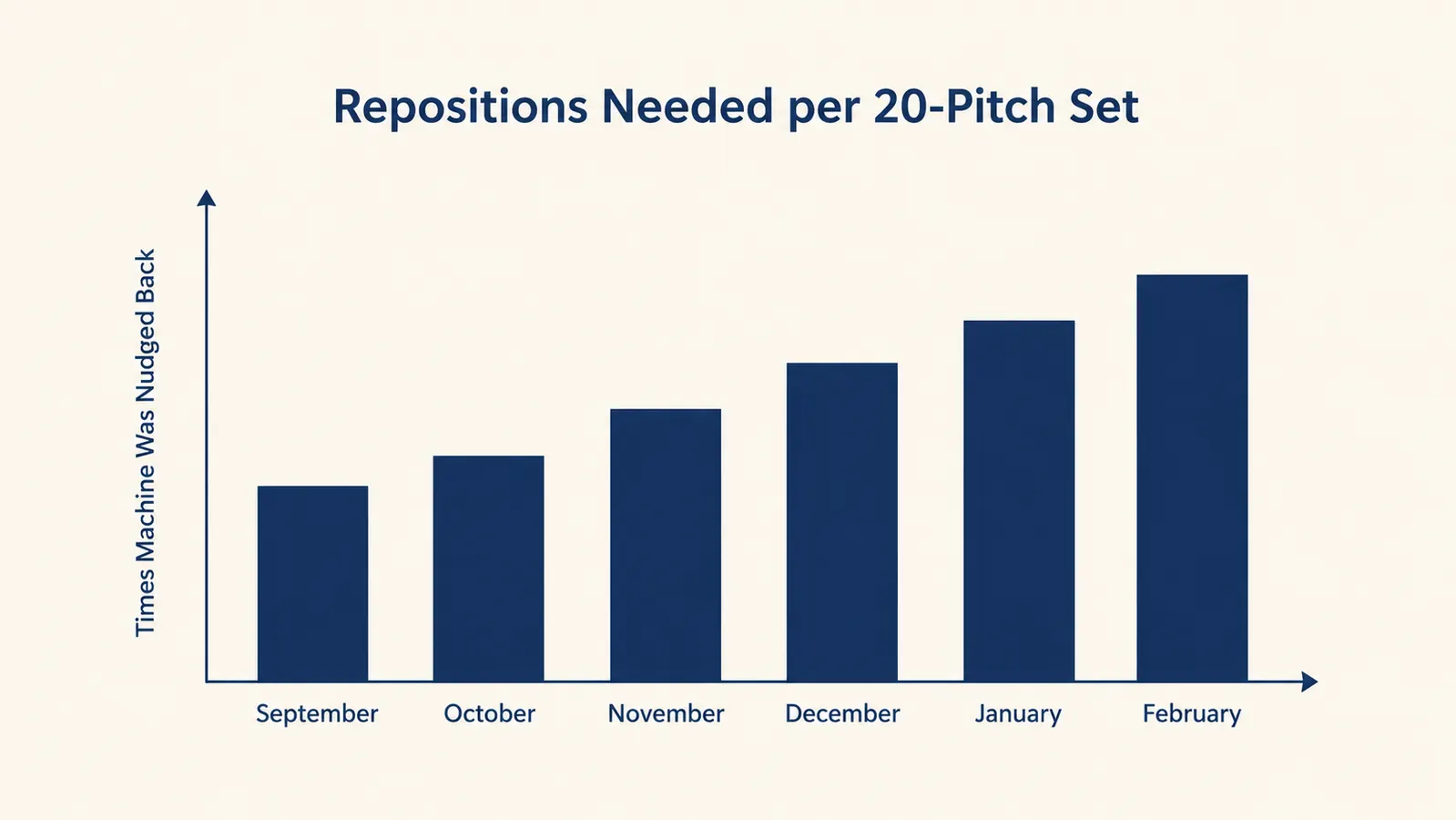
We also noticed the rubber feet on the tripod legs grip differently on cold concrete than they do on warm grass or a summer driveway. On a smooth, cold surface, the machine crept forward a few inches over the course of a longer session, pitch after pitch nudging it slightly out of position until the release point had drifted enough that Rowan noticed her timing feeling off. We started checking the machine's position every 15 to 20 pitches once we noticed the pattern, and a quick nudge back to our marked spot, we use a strip of painter's tape on the concrete, solved it in under a minute each time. It's a small thing, but it's exactly the kind of small thing that never makes it into a five-minute unboxing review.
There's also a comfort-of-use cost to cold weather that has nothing to do with the machine itself. Feeding balls into the hopper with numb fingers gets old fast, and Rowan started wearing batting gloves during warmups just to have something on her hands between swings while I loaded the next round. None of that is the machine's fault, but if you're planning on genuinely year-round use rather than a warm-season purchase, it's worth building that friction into your expectations.
It Throws Overhand, Not Windmill, and That Matters for Fastpitch
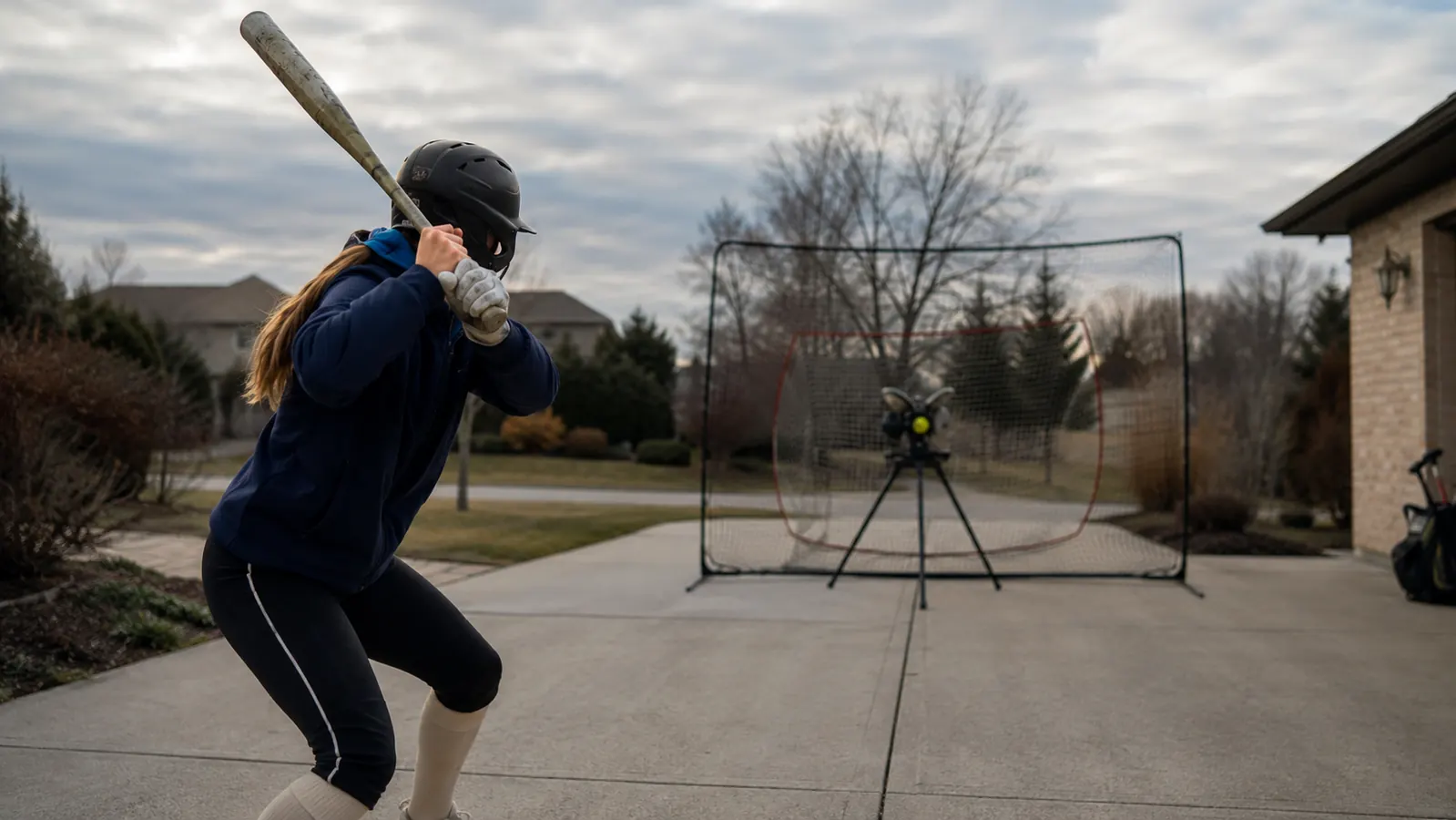
Here's the piece I most want a softball parent to read before buying. This machine throws with an overhand wheel motion, the same basic mechanism used across most consumer pitching machines regardless of sport. Real fastpitch softball pitching is windmill, underhand, with rise, drop, and curve that come from spin generated in a completely different release. The Blue Flame cannot replicate that motion, full stop, and no amount of speed adjustment changes the trajectory shape.
That doesn't make it useless for a softball hitter, but it changes what you're actually training. Rowan's timing against a consistent, repeatable pitch improved noticeably over our sessions, and being able to track a ball out of a machine instead of an inconsistent parent-thrown pitch is genuinely valuable for building bat path and contact habits. What it will not do is prepare her for the rise ball a real fastpitch pitcher throws on a 3-1 count. If your goal is simulating live game pitching for a softball hitter, this machine solves half the problem, the repeatability half, and does nothing for the other half, the pitch shape half. I wish a reviewer had told me that plainly before I bought it, because I'd have set my expectations differently from the start.
Her hitting coach actually flagged this for us a few weeks in, pointing out that Rowan's approach at the plate against real pitchers hadn't changed much even though her contact against the machine had gotten noticeably cleaner. His read was that the machine was doing exactly what a machine like this can do, building rhythm and bat-to-ball consistency, and that we shouldn't expect it to carry over into recognizing pitch movement in a real at-bat. That matched what I'd started suspecting myself, and it's the kind of context I wish had been on the product page instead of something I had to piece together over a season.
The Creep, the Cord, and Other Small Annoyances
Beyond the cold-weather creep already mentioned, a few other small things add up over a season of regular use. The included power cord is short, short enough that our garage-outlet setup was really the only configuration that worked without buying a separate outdoor-rated extension cord, since running one across a wet or icy threshold felt like a bad tradeoff for the convenience. If your outlet situation isn't as forgiving as ours, factor that cord length into where you can realistically set this machine up.
There's also no included case or bag for the machine itself, just the tripod and hopper as separate pieces if you do break it down, so we ended up buying a cheap storage tote to keep the smaller parts from rolling around the garage floor. And the hex key that ships with it for the initial assembly is thin enough that I stripped one screw head slightly getting the tripod legs tightened, nothing that affected function, but I switched to my own hex key set for any later adjustments rather than risk it again.
What I Looked at Before Buying
Before settling on the Louisville Slugger Blue Flame, I compared it against a couple of dedicated softball-specific machines that claim to throw a version of underhand motion with some spin, marketed more directly at fastpitch training. Those machines run considerably higher in price and, based on what I read from parents who own them, still don't fully replicate a real pitcher's rise or drop, they just get marginally closer at a real cost premium. Given that gap, and given that Rowan's actual need was more reps and better timing rather than a perfect pitch simulator, the Blue Flame's lower price and general-purpose overhand throw made more sense for our situation.
I also briefly considered skipping a machine entirely and just paying for more cage time at a local indoor facility instead. That would have solved the cold-weather problem completely, since it's climate controlled, but it would have meant scheduling around their hours and driving fifteen minutes each way for every session instead of walking into our own garage whenever Rowan had twenty free minutes. For us, the convenience of owning the machine outweighed the climate control an indoor facility offers, but if you've got a good cage nearby and don't mind the drive, it's a legitimate alternative worth pricing out before you buy anything.
What I Liked
- Repeatable, consistent pitches that genuinely helped timing and contact over a full off-season
- Handles a wide speed range from slow toss up into the high 50s for adult cuts
- Garage-and-driveway setup with a nearby outlet meant no extension cord needed
- Held up mechanically through cold weather with only minor feed hesitation, no real failures
- Priced well below dedicated softball-specific machines that claim closer pitch simulation
Where It Falls Short
- Real assembled weight and top-heavy balance feel heavier than the spec sheet suggests
- No included storage case, and it takes real garage floor space if left assembled
- Occasional double-feed or hesitation in cold temperatures below freezing
- Creeps out of position on smooth, cold concrete and needs regular repositioning
- Throws overhand only, so it cannot replicate windmill fastpitch rise or drop for softball hitters
It solved the repeatability problem completely. It never touched the pitch-shape problem at all, and nothing at this price will.
Who This Is For
This machine makes the most sense for a parent who wants affordable, repeatable batting practice for a baseball or softball player and understands going in that it's a timing and contact tool, not a pitch-simulation tool. It's a good fit if you have a driveway, garage, or yard setup with an outlet nearby, and if your player is somewhere in the range between house league and mid-level travel ball where raw reps matter more than facing a perfectly game-accurate pitch. It also works well for an adult rec player who just wants extra swings without needing a second person to throw, cold weather included, as long as you're realistic about the minor feed quirks that come with using it outside of ideal conditions.
Who Should Skip It
If you're specifically trying to prepare a fastpitch softball hitter for live game pitching with rise, drop, or curve, this machine won't get you there, and you should look at dedicated softball-specific machines instead, even at a higher price. I'd also skip it if you don't have a stable, ideally covered, outlet-accessible setup, since cold, wet, or uneven surfaces expose the creep and feed issues we ran into more than a clean summer lawn would. And if storage space is tight, the lack of a proper case is a real, ongoing annoyance worth weighing before you buy.
Now that you know the real weight and the real limitations, decide if it still fits your setup.
We'd still buy this machine again knowing everything above. If a repeatable, honest tool for off-season reps sounds right for your driveway or garage, check today's price and current availability on Amazon.
Amazon Check Today's Price on Amazon →